The Endocrine System and Hormones
· 26 min read · Humanome
A calm, visual guide to the chemical network that quietly runs your body, one hormone at a time.
You have more than 50 different hormones circulating in your body right now, and a single drop of one of them, in an amount too small to see, can change your heart rate, your mood, your appetite, and your body temperature within minutes - Cleveland Clinic, Endocrine System. Most of us never notice this system at all, because unlike a beating heart or a filling breath, hormones work invisibly and slowly. This guide is a careful tour of that hidden network: what a hormone actually is, which glands make them, and why so much of how you feel comes down to a few chemical messages traveling through your blood.
The endocrine system is easy to overlook precisely because it is so quiet. When it works, you feel steady. When it drifts, the effects can be baffling: unexplained fatigue, weight that will not budge, a racing pulse, thirst that never quits. Understanding the system is the first step to understanding those signals. Throughout this guide you can open the live 3D model and find each gland in its real place. Humanome is an interactive 3D explorer of the body, and the hormone-making glands are structures you can click into, light up, and read.
Contents
- Two messaging systems: the fast one and the slow one
- What a hormone actually is
- Feedback loops: how the body holds a set point
- The hypothalamus and pituitary: the master control
- The thyroid: your metabolic thermostat
- When the thermostat drifts: hypothyroidism and hyperthyroidism
- The pancreas, insulin, and blood sugar
- Type 2 diabetes: when the signal stops working
- The adrenal glands: cortisol, adrenaline, and the stress response
- The other glands, and how to support endocrine health
- See it in 3D and keep exploring
- The takeaway
1. Two messaging systems: the fast one and the slow one
Your body runs on two great communication networks, and the whole endocrine system makes more sense once you see it next to its faster twin. The first network is the nervous system, which sends electrical signals down nerves at astonishing speed. When you touch something hot and yank your hand back before you have even registered the pain, that is the nervous system: fast, precise, and short-lived. A nerve signal reaches its target in a fraction of a second, does its job, and is gone. It is perfect for anything that has to happen right now and stop just as quickly.
The second network is the endocrine system, and it works in almost the opposite way. Instead of firing a signal down a wire to one specific spot, an endocrine gland releases a chemical messenger into the bloodstream, which carries it everywhere. The message is slow, widespread, and long-lasting. It can take seconds, minutes, or even hours to take full effect, and its influence can last far longer, sometimes for days. This is the system you want for anything that has to be sustained and coordinated across the whole body: growing, digesting, regulating your energy, handling stress, or holding your internal chemistry steady through the night.
The two systems are not rivals. They are partners that divide the labor by timescale. If the nervous system is the body's telephone network, the endocrine system is its postal service: slower, but able to send the same message to millions of cells at once. Our companion guide to the brain and nervous system covers the fast half of this story; this article is about the slow, chemical half, and how it quietly keeps you in balance.
Hold that contrast in mind and the rest of this guide follows naturally. Every hormone question people search for, what the thyroid does, how insulin works, what cortisol is, is really a question about the same underlying machine: a gland releasing a chemical message into the blood to change how distant organs behave. Let us start with the message itself.
2. What a hormone actually is
A hormone is a chemical messenger. That is the entire idea, and it is worth saying plainly because the word sounds more mysterious than it is. An endocrine gland manufactures a specific molecule, releases it into the bloodstream, and that molecule travels until it reaches cells built to receive it, where it delivers an instruction: speed up, slow down, store this, release that, grow, hold steady - MedlinePlus, Hormones. Hormones coordinate an enormous range of functions, from metabolism and growth to mood, sleep, and reproduction, and they do it all by carrying messages through the blood.
The elegant part is the addressing. A hormone floods the entire bloodstream and touches nearly every cell, yet only certain cells respond. That is because a cell responds to a hormone only if it carries the matching receptor, a protein shaped to lock onto that specific molecule the way a key fits one lock. A cell without the receptor simply ignores the hormone as it drifts past. This is why one messenger can travel everywhere and still deliver a targeted instruction: the message goes out to all, but only the intended recipients can read it. The gland that makes the hormone is the sender, and the organ with the matching receptors is the target organ.
Two facts about hormones surprise most people. The first is how little of them it takes. Hormones act at tiny concentrations, and a very small amount can trigger a large, body-wide change, which is exactly why having a little too much or too little of one hormone can throw you off so dramatically. The second is how many there are. You produce more than 50 distinct hormones, each with its own job, and they affect nearly every aspect of your health, directly or indirectly - Cleveland Clinic, Hormones. Most work in the background, so quietly that you only learn their names when one of them goes wrong.
The glands that make these messengers are spread throughout the body, not gathered in one organ. The major players include the pituitary and hypothalamus in the brain, the thyroid and parathyroids in the neck, the adrenal glands atop the kidneys, the pancreas behind the stomach, and the reproductive glands. You can find most of these in the organs system view of the explorer, tucked into their real positions. Each gland makes its own set of hormones, and together they form a distributed control network with no single headquarters, though one region comes close, as we will see.
3. Feedback loops: how the body holds a set point
Here is the concept that turns the endocrine system from a list of glands into a machine you can understand: the feedback loop. Nearly every hormone system in your body is regulated the same way a thermostat regulates a room, and once you see the pattern, thyroid disease, diabetes, and the stress response all become variations on one theme. A thermostat has a set point, the temperature you want. It measures the actual temperature, compares it to the set point, and acts to close the gap: too cold, turn on the heat; warm enough, turn the heat off. Your hormones do exactly this, but for things like blood sugar, calcium, and metabolic rate.
The specific mechanism the body uses is called negative feedback, and the word "negative" is the key. It means the output of the system feeds back to shut the system down once the goal is reached, preventing overshoot. Consider a general example: the brain senses that a hormone's effect is low, so it signals a gland to release more; the level rises; and that rising level then signals the brain and gland to stop. The response opposes the change that triggered it, which is what keeps the level hovering near the set point instead of swinging wildly. It is the same restraint that stops a heater from cooking a room the moment it hits the target temperature.
This loop structure explains both health and disease. When the loop works, a hormone stays in a narrow, healthy range no matter what you throw at it: a big meal, a cold morning, a stressful commute. When a loop breaks, the level drifts out of range and stays there, and that drift is what a doctor measures in a blood test. Many endocrine diagnoses come down to reading one such loop:
- A low hormone with a high control signal often means the target gland is failing to respond.
- A high hormone with a low control signal often means the gland is overactive and the brain is trying to rein it in.
- A normal level held steady through daily ups and downs means the loop is intact.
That short list is, in essence, how endocrinologists think. Rather than memorizing dozens of diseases, they ask which loop is broken and in which direction. The rest of this guide applies exactly that lens to the three systems people ask about most: the thyroid, blood sugar, and stress. But every one of them is governed from the same place, so we start at the top of the chain of command.
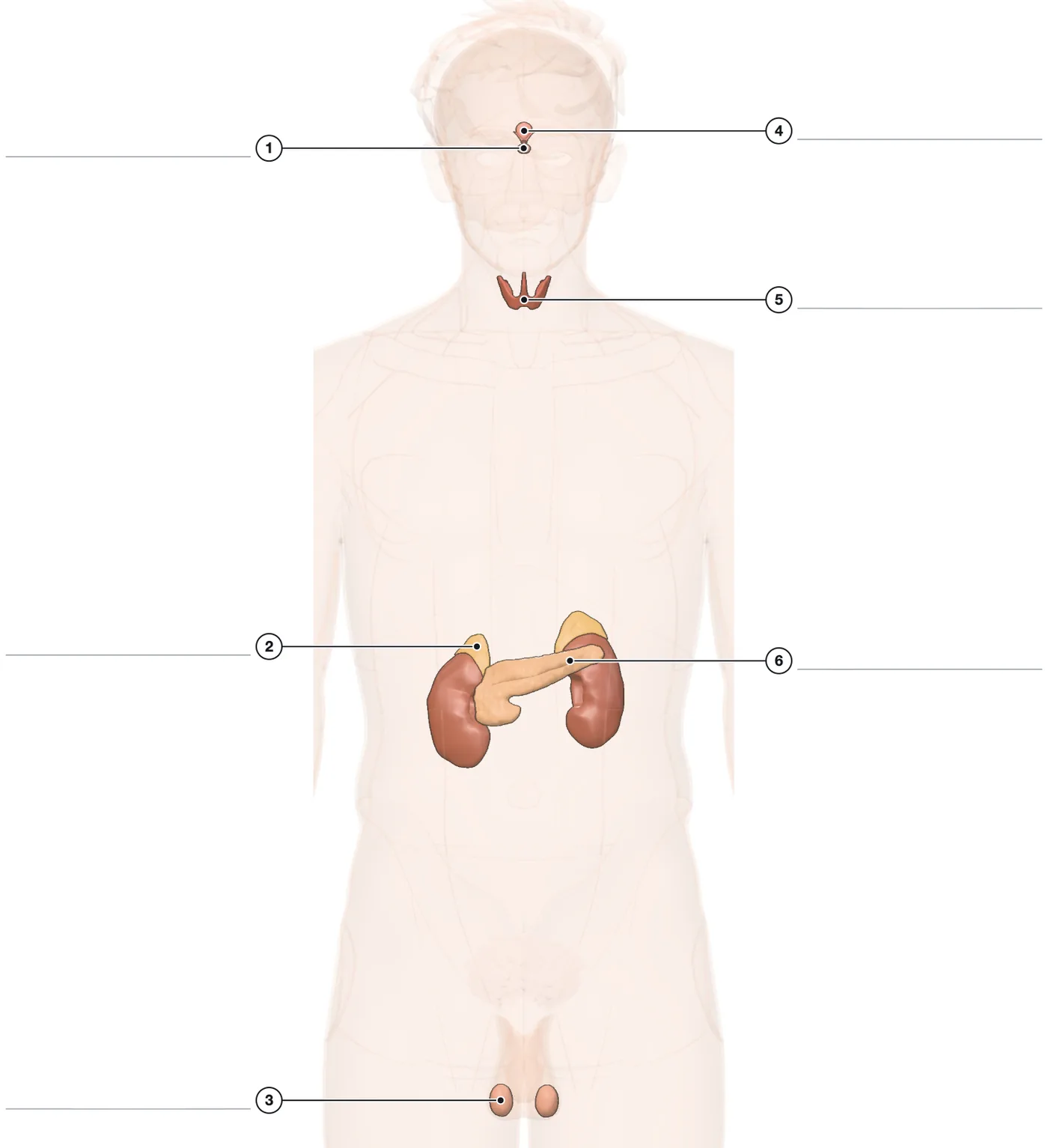
Label it yourself: the endocrine system
Drag each name onto its line, or tap a name and then its line, and check your answers.
Word bank
0 of 6 placed
Drag a name onto its numbered line, or tap a name and then the line.
Your answers
- 1
- 2
- 3
- 4
- 5
- 6
4. The hypothalamus and pituitary: the master control
Deep in the base of your brain sit two small structures that together act as the endocrine system's command center. The first is the hypothalamus, roughly the size of an almond, which is the main bridge between your nervous system and your hormones - Cleveland Clinic, Endocrine System. This is where the fast electrical world and the slow chemical world meet. The hypothalamus constantly monitors the body's internal state (temperature, hunger, hydration, stress) and translates what it senses into hormonal commands, handing them down to the gland just below it.
That gland is the pituitary, and it is famously small: about the size of a pea, weighing less than a paperclip - Cleveland Clinic, Pituitary Gland. Despite its size, it is often called the master gland, because it tells so many other endocrine glands what to do. Taking orders from the hypothalamus above it, the pituitary releases its own hormones that travel to distant glands and switch them on. Two of these are central to this guide. TSH (thyroid-stimulating hormone) tells the thyroid how much thyroid hormone to make. ACTH (adrenocorticotropic hormone) tells the adrenal glands to release cortisol. The pituitary also makes growth hormone and several others that govern reproduction and water balance.
This creates a tidy chain of command, and it is where the feedback loops from the last section live. The pattern, repeated across the body, is a three-step axis: the hypothalamus signals the pituitary, the pituitary signals a target gland, and the target gland releases the working hormone. Then the level of that final hormone feeds back up the chain to keep the whole thing in check:
The command chain: hypothalamus (senses the body's state) sends a releasing signal to the pituitary (the master gland), which sends a stimulating hormone like TSH or ACTH to a target gland like the thyroid or adrenals, which releases the working hormone. When that working hormone rises high enough, it signals the hypothalamus and pituitary to ease off, closing the loop.
Because so much runs through this one complex, a problem here can ripple across many hormones at once, which is why pituitary disorders can be so wide-ranging. But most of the time the master gland does its job silently, dialing each downstream gland up and down to hold every level near its set point. With the chain of command in place, we can follow it down to the first target gland people ask about: the thyroid.
5. The thyroid: your metabolic thermostat
The thyroid is a butterfly-shaped gland that wraps around the front of your windpipe, low in the neck, and it is only about 2 inches long - Cleveland Clinic, Thyroid. In a healthy person you cannot see it or feel it, yet it sets the pace for nearly every cell in your body. Its single great job is to control your metabolism: the rate at which your cells turn food into usable energy. If the endocrine system has a thermostat for how hot you run, this is it. You can open the thyroid gland in the 3D model to see exactly where it sits, straddling the trachea just below the voice box.
The thyroid does its work with two hormones, known by shorthand as T4 and T3. It releases mostly T4 (thyroxine), which acts as a kind of stored, slower form, and the body converts it into T3 (triiodothyronine), the more active version that has the greater effect on metabolism. Making these hormones requires iodine from your diet, which is one reason iodized salt exists: without enough iodine, the gland cannot build its hormones. Once released, thyroid hormone travels everywhere and gently pushes the pace of countless processes, influencing your heart rate, body temperature, digestion, and energy. Turn it up and everything runs a little faster and hotter; turn it down and everything slows and cools.
Crucially, the thyroid does not decide its own output. It sits at the bottom of the command chain from the last section, taking its orders from the pituitary through TSH. When the level of thyroid hormone in the blood drops, the pituitary senses it and releases more TSH, prodding the thyroid to work harder. When thyroid hormone climbs high enough, TSH falls and the thyroid eases off. This is the negative feedback loop in its purest form, and it is why a simple TSH blood test is so revealing: a high TSH usually means the pituitary is shouting at a sluggish thyroid, while a low TSH often means the thyroid is running hot and the pituitary has gone quiet trying to slow it. When that loop drifts in either direction, you get the two most common thyroid conditions.
6. When the thermostat drifts: hypothyroidism and hyperthyroidism
Thyroid problems are common, and they are one of the clearest illustrations of a feedback loop drifting out of range. Roughly 20 million Americans have some form of thyroid disease, and women are affected far more often than men. The two headline conditions are opposites: too little hormone, or too much. Understanding them is largely a matter of remembering that thyroid hormone is the body's accelerator. Too little, and everything slows down. Too much, and everything speeds up.
Hypothyroidism is an underactive thyroid: the gland does not make enough hormone, so the whole body downshifts. It is strikingly common, affecting nearly 5 in 100 Americans ages 12 and older, though many cases are mild - NIDDK, Hypothyroidism. The most frequent cause is Hashimoto's disease, an autoimmune condition in which the immune system slowly attacks the thyroid. Because metabolism slows, the symptoms are a catalog of "everything running low": fatigue, weight gain, feeling cold, dry skin, thinning hair, constipation, slowed heart rate, and low mood. It develops gradually and quietly, which is why it is often missed for years and why a routine blood test catches it. You can explore hypothyroidism in 3D to see the gland involved, or read more on the crawlable hypothyroidism condition page.
Hyperthyroidism is the mirror image: an overactive thyroid flooding the body with hormone, so everything runs too fast. It affects about 1 in 100 Americans ages 12 and older, and its most common cause is Graves' disease, another autoimmune condition, this time one that overstimulates the gland - NIDDK, Hyperthyroidism. The symptoms are the opposite of an underactive thyroid: weight loss despite eating more, a rapid or irregular heartbeat, anxiety and irritability, trouble sleeping, shaky hands, sweating, and difficulty tolerating heat. Some people also develop a visibly enlarged thyroid, called a goiter. You can light up hyperthyroidism in the model or read the crawlable hyperthyroidism condition page. Set the two side by side and the logic is clean: one gland, one accelerator, two directions it can fail.
The reassuring part is that both conditions are treatable, and treatment is aimed squarely at the broken loop. For an underactive thyroid, a daily dose of synthetic thyroid hormone replaces what the gland cannot make, restoring the level the pituitary is asking for. For an overactive thyroid, medications, radioactive iodine, or surgery bring the runaway output back down. In both cases, doctors track the same TSH blood test we met earlier to confirm the loop has been coaxed back toward its set point. The thyroid is a small gland with large reach, and getting its output right can turn a foggy, exhausted, or jittery person back into themselves. Pharmacists answer questions about daily tablets like these all the time, and a pharmacist who wants to grade AI answers about drugs and dosing next to the job can see which rules apply in a free check on AITraining.jobs, a companion project of ours.
7. The pancreas, insulin, and blood sugar
Behind your stomach lies the pancreas, a gland with two very different jobs. Most of it makes digestive enzymes that break down food, a story we tell in our guide to the digestive system. But scattered through it are small clusters of hormone-making cells called the islets, and these run one of the most important control systems in the body: the regulation of blood sugar, or blood glucose. Glucose is the fuel your cells burn for energy, and keeping its level in the blood within a narrow band is a matter of survival. Too low starves the brain; too high slowly damages vessels and organs. You can find the pancreas among the other organs in the organs system view.
The islets hold this balance with two opposing hormones, and it is the cleanest feedback loop in this whole guide. When you eat and blood sugar rises, the islets release insulin. Insulin is the hormone that tells cells throughout your body to take glucose out of the blood, either to burn it for energy or to store it for later, which pulls the level back down. When blood sugar falls (say, between meals or overnight), the islets release a second hormone, glucagon, which tells the liver to release stored glucose back into the blood, pushing the level up. Between them, insulin and glucagon act like a two-pedal control system, one braking, one accelerating, holding blood sugar remarkably steady around the clock.
Insulin is worth understanding on its own, because it is the hormone at the center of the most-searched endocrine question of all: how does insulin work in diabetes. Think of insulin as a key. Glucose cannot drift into most cells on its own; the cell's door stays shut. Insulin is the key that unlocks that door, letting glucose leave the bloodstream and enter the cell where it can be used - NIDDK, Type 2 Diabetes. No insulin, or insulin that the lock no longer recognizes, and glucose piles up outside the cells, high in the blood but useless to the tissues that need it. That single mechanism, the key and the lock, is the whole basis for understanding diabetes.
This system is also a beautiful example of why the endocrine design uses the bloodstream. A meal's glucose spreads through the whole circulation, so the correction has to reach every cell at once, and only a hormone poured into the blood can tell your muscles, your liver, and your fat tissue all at the same time to absorb the incoming sugar. When that message gets through, you never notice. When it stops getting through, the result is one of the defining diseases of our era.
8. Type 2 diabetes: when the signal stops working
Diabetes is what happens when the blood sugar loop fails and glucose stays chronically too high. It is not a rare disease; it is one of the most widespread chronic conditions in the country. About 38 million Americans have diabetes, and by the most recent estimates that figure has climbed past 40 million, while a staggering 98 million US adults have prediabetes, blood sugar that is elevated but not yet in the diabetic range - CDC, Diabetes Statistics. The overwhelming majority of these cases, 90 to 95 percent, are type 2 diabetes, which is the form this section is about - CDC, Diabetes Statistics.
Type 2 diabetes is fundamentally a key-and-lock problem, and it usually unfolds in two stages. First comes insulin resistance: the cells stop responding well to insulin, as if the locks have grown stiff and the key no longer turns easily. To compensate, the pancreas makes more and more insulin, shouting louder to be heard, and for a while this keeps blood sugar near normal. Over time, though, the overworked islets cannot keep up, insulin production falls behind demand, and blood sugar climbs into the diabetic range - NIDDK, Type 2 Diabetes. The result is glucose stranded in the blood, high enough to slowly damage the body while the cells that need it go hungry. You can explore type 2 diabetes in 3D or read the crawlable type 2 diabetes condition page.
Why does chronically high blood sugar matter so much? Because glucose that lingers in the blood at high levels quietly damages the smallest vessels and nerves over years, which is why untreated diabetes is a leading driver of heart disease, kidney failure, vision loss, and nerve damage. The vessels of the heart are an early casualty, a link explored in our guide to how the human heart works, and the kidneys, which filter that sugar-laden blood, are another, covered in how your kidneys work. The damage is slow and painless at first, which is exactly what makes it dangerous, and it is why so many people have prediabetes without knowing it.
The hopeful side is that type 2 diabetes responds strongly to the same levers that prevent it, because it is so closely tied to how we live. Weight, physical activity, and diet all shift how well cells respond to insulin, which means the loop can often be nudged back toward function. Losing even a modest amount of weight, moving more, and eating in a way that avoids large sugar spikes can lower blood sugar meaningfully, and for people with prediabetes, these changes can delay or prevent the disease from developing at all - CDC, Diabetes Statistics. It is one of the clearest cases in medicine where understanding the mechanism, a hormone key that has stopped turning, points directly at what helps. Medicines are a separate question: no current GLP-1 label lists prediabetes as an approved use, and GLPcompare, a drug reference we also run, sets out what the trials in prediabetes have found.
9. The adrenal glands: cortisol, adrenaline, and the stress response
Perched like small caps on top of each kidney sit the adrenal glands, and they are the reason your body can respond to a threat before you have finished thinking about it - Cleveland Clinic, Adrenal Gland. Each is only about half an inch high, yet they produce some of the most powerful hormones in the body. Their position atop the kidneys is worth noting, because the kidneys and adrenals cooperate closely on blood pressure and fluid balance, a partnership covered in how your kidneys work. You can open the left adrenal gland and the right adrenal gland in the model to see them sitting on their kidneys.
Each adrenal gland has two layers making different hormones, and three of them matter most here. The inner layer makes adrenaline (also called epinephrine), the instant "fight or flight" hormone. The outer layer makes cortisol, the slower, longer-acting stress hormone, and aldosterone, which manages blood pressure by controlling how much sodium and water the kidneys hold onto - Cleveland Clinic, Adrenal Gland. Aldosterone is the endocrine partner to the fluid-balancing hormone ADH, part of the same pressure-and-water control system the kidneys run. Together these three hormones let the adrenals handle both sudden emergencies and long, grinding demands.
The stress response shows all three working together. When your brain perceives a threat, the hypothalamus sets off an alarm, and within seconds adrenaline floods your system: your heart pounds, your blood pressure rises, your airways open, and glucose pours into your blood for quick fuel, the pounding pulse of a near-miss in traffic - Mayo Clinic, Chronic Stress. This is the same adrenaline that raises heart rate and blood pressure, a link to how the human heart works. Close behind it, cortisol rises more slowly to sustain the response: it raises blood sugar, sharpens the brain's use of fuel, and temporarily dials down systems you do not need in a crisis, like digestion and immune activity. In a genuine emergency, this is a life-saving surge that fades once the threat passes.
The trouble comes when the alarm never fully switches off. When stress is chronic, the fight-or-flight system stays partly turned on and cortisol stays elevated, and long-term exposure to that surplus can disrupt almost every process in the body - Mayo Clinic, Chronic Stress. Persistent stress hormones are linked to high blood pressure, weight gain, sleep problems, digestive trouble, anxiety, and a higher risk of heart disease over time. This is the honest reason stress management is not a luxury but a genuine part of endocrine health: the adrenal system is built for short sprints, not for staying switched on indefinitely, and giving it a chance to power down is one of the most useful things you can do for the whole network.
10. The other glands, and how to support endocrine health
A few smaller glands round out the system and deserve a mention, because they show how specialized these chemical messengers can be. The four parathyroid glands, tiny nodes behind the thyroid, do one precise thing: they manage the level of calcium in your blood, which matters not only for bones but for nerves and muscles to work at all. The pineal gland, buried deep in the brain, makes melatonin, the hormone that rises in darkness and helps set your sleep-wake cycle. And the reproductive glands (ovaries and testes) produce the sex hormones that drive development and fertility. Each is a reminder that the endocrine system is less a single organ than a committee of specialists, all releasing messages into the same shared bloodstream.
So how do you support a system this distributed and this quiet? The honest answer is that you cannot micromanage individual hormones through lifestyle, and you should be wary of anyone who claims a supplement will "balance" them. What you can do is give the whole network the stable conditions it needs to self-regulate, and those conditions turn out to be the familiar fundamentals, working because they touch the loops we have discussed:
- Protect your sleep. Consistent, sufficient sleep steadies melatonin, cortisol, and appetite hormones, and poor sleep disrupts all three.
- Move your body regularly. Physical activity improves how cells respond to insulin, a direct lever on blood sugar control.
- Eat in a steady, balanced way. Meals lower in refined sugar and rich in whole foods avoid the large glucose spikes that strain the insulin system.
- Manage chronic stress. Giving the adrenal system real chances to power down keeps cortisol from staying elevated.
- Get screened when it is due. Simple blood tests catch thyroid and blood sugar problems early, often before symptoms appear.
That last point carries more weight than it seems. The two most common endocrine problems in this guide, thyroid dysfunction and type 2 diabetes, are both easy to miss because they develop slowly, yet both are caught by ordinary blood tests and both are highly treatable when found early - NIDDK, Hypothyroidism. No lifestyle habit replaces that screening. If you feel persistently exhausted, unusually thirsty, or notice unexplained weight change, a racing heart, or a lasting shift in mood, those can be hormonal signals worth a conversation with a clinician. The endocrine system rewards attention: give it steady sleep, movement, decent food, less relentless stress, and a routine check now and then, and it will mostly run itself.
11. See it in 3D and keep exploring
Reading about hormones is one thing. Finding the gland that makes them, sitting in its real place in the body, is another. Everything in this guide (the thyroid wrapped around the windpipe, the pancreas behind the stomach, the adrenal glands capping the kidneys) is waiting for you in the live model. This is exactly what Humanome was built for: to make the body explorable by anyone, with no medical training required.
Start at the explorer home and open the organs system view to see the hormone-making glands in context. Click the thyroid gland to find your metabolic thermostat, then trace down the body to the left adrenal gland and the right adrenal gland sitting atop the kidneys. Then search any of thousands of conditions and watch the exact structures they affect light up: hypothyroidism, hyperthyroidism, or type 2 diabetes. Seeing which part of the body a hormone condition touches makes the mechanism stick in a way words alone cannot.
To study the glands for a test, the endocrine glands and hormones chart puts every gland, its hormones, what each acts on and what it does in one printable table.
The endocrine system does not work alone, and neither should your exploration of the body. The blood that carries every hormone is moved by the heart, so read how the human heart works to see the pump behind the postal service. The insulin story continues into digestion, covered in the digestive system, and the adrenal glands share their fluid-and-pressure work with the kidneys in how your kidneys work. The fast messaging system that partners with this slow one is mapped in the brain and nervous system. Each system connects to the hormones, and the explorer lets you move between them freely.
12. The takeaway
Strip away the jargon and the endocrine system is a single, elegant idea: a set of glands that release chemical messengers into the blood to coordinate the body slowly and widely, the calm counterpart to the fast electrical nervous system. Nearly every hormone question comes down to one gland sending one message to a distant target organ, and nearly every hormone disease comes down to a feedback loop drifting out of its healthy range: a thyroid running too slow or too fast, an insulin key that no longer turns, a stress alarm that will not switch off. Understand the loop and you understand the disease, and you also understand why steady sleep, movement, sensible food, less chronic stress, and the occasional blood test protect nearly all of it at once. It is the quietest system you own, and now you can see it working in 3D.
This article is for general education, not medical advice. It cannot diagnose or treat any condition. If you have concerns about your thyroid, blood sugar, energy, weight, or any hormonal symptom, please consult a qualified clinician, and in an emergency call your local emergency number right away.