The Brain and Nervous System
· 24 min read · Humanome
Your body is a three-pound universe. It runs on electricity, rebuilds its own wiring, and never once asks your permission to keep you breathing.
Right now, without any effort on your part, roughly 86 billion neurons are trading signals inside your skull, each one connected to thousands of others in a web so dense it has more connections than there are stars in the Milky Way - Azevedo et al. 2009, J Comp Neurol. That web is reading these words, holding your posture, timing your heartbeat, and deciding what to have for lunch, all at the same time. This guide is a tour of that system: how a single nerve cell fires, how billions of them build a brain, how the brain talks to the rest of the body, what happens when the wiring fails, and how to keep it healthy. You can follow along in three dimensions the whole way. Open the live 3D explorer, peel the model down to its nervous layer, and watch this network light up as one connected thing rather than a diagram on a page.
Contents
- What the nervous system is for
- The neuron: the body's basic wire
- Central and peripheral: two halves of one system
- The brain, region by region
- The spinal cord and the reflex arc
- How the brain is protected and fed
- What can go wrong
- Caring for your brain and nervous system
- Explore it yourself
1. What the nervous system is for
Every living body faces the same engineering problem: the parts are far apart and the world moves fast. A hand needs to know, in milliseconds, that a stove is hot. Lungs need to speed up the instant you start running. Your eyes, ears, gut, muscles, and glands all need to act as one coordinated organism rather than a bag of independent organs. The nervous system is the body's answer to that problem. It is a high-speed communication and command network that senses what is happening inside and outside you, decides what to do about it, and sends orders back out, thousands of times per second, for your entire life - Cleveland Clinic: Nervous System.
It helps to think of the system as doing three jobs in a loop. First it senses: receptors in your skin, eyes, ears, muscles, and organs constantly gather information. Then it integrates: the brain and spinal cord compare that information against memory, reflex, and goal, and choose a response. Finally it commands: signals travel back out to muscles and glands to move you, adjust you, or protect you. This sense-decide-command cycle is happening for the words on this screen and for your breathing rate at the exact same moment, most of it entirely below your awareness. The nervous system works closely with the two other great control systems of the body, the beating heart and the breathing lungs, both of which it quietly governs. You can read how those partners work in How the Human Heart Works and How Your Lungs Work.
What makes the nervous system special is its speed and precision. Your hormones can also carry messages, but they drift through the bloodstream over seconds to minutes and reach the whole body at once. Nerves, by contrast, send a targeted electrical pulse to exactly one destination in a fraction of a second. That combination of speed and specificity is why you can catch a falling glass, flinch from a spark, or play a piano run faster than you can consciously think. To see the network as a single web instead of a list of parts, it helps to rotate it in space, which is exactly what the explorer's nervous layer lets you do, or you can browse the whole nervous system as one connected map.
2. The neuron: the body's basic wire
Zoom all the way in and the entire nervous system is built from one repeating unit: the neuron, or nerve cell. A neuron has three working parts. The dendrites are the branching antennae that receive incoming signals. The cell body (soma) holds the nucleus and keeps the cell alive. And the axon is the long output cable that carries the neuron's own signal onward, sometimes just a fraction of a millimeter to a neighbor, sometimes a full meter down your leg - NINDS: The Life and Death of a Neuron. Multiply this one design by roughly 86 billion copies in the brain alone, each wired to thousands of others, and you have the physical basis of everything you have ever felt, learned, or decided - Azevedo et al. 2009.
A signal inside a neuron is not a metaphor for electricity, it genuinely is electrical. When a neuron is stimulated enough, it fires an action potential, a brief electrical spike that races down the axon like a spark along a fuse. But neurons do not physically touch. Where one neuron's axon meets the next cell there is a microscopic gap called the synapse, and the electrical signal cannot jump it directly. Instead the arriving spike triggers the release of chemical messengers called neurotransmitters, which float across the gap and land on the next cell's dendrites, either nudging it toward firing or calming it down. So every thought is a relay race that switches between two languages: electrical down the wire, chemical across the gap, over and over, billions of times a second.

Neurons do not work alone. For every neuron there is a small army of glial cells, the support crew that feeds neurons, cleans up waste, fights infection, and holds the whole structure together. One kind of glial cell does something remarkable: it wraps axons in myelin, a fatty insulating sheath left with tiny bare gaps along its length. Myelin transforms how fast a signal can travel. Instead of creeping smoothly down the whole axon, the electrical spike leaps from gap to gap in a process called saltatory conduction (from the Latin for "to jump"), and this makes it dramatically faster - NCBI Bookshelf: Neuroscience, conduction velocity.
The speed difference is not small. A thin, unmyelinated fiber (the kind carrying a slow, dull ache) may conduct at only about 1 meter per second, while a thick, heavily myelinated fiber (the kind carrying sharp touch or a movement command) can reach up to roughly 120 meters per second, over 250 miles per hour - NCBI Bookshelf: Neuroscience. That is why you feel the sharp prick of a needle instantly but the deep ache arrives a moment later: they travel on different wires at different speeds.
The takeaway from this level is simple but profound: your mind is not a mysterious cloud, it is a physical network of cells passing electrical and chemical signals along insulated wires. Understanding that one unit, the neuron, unlocks everything above it. When we later look at conditions like multiple sclerosis (an attack on myelin) or Parkinson's disease (a loss of one neurotransmitter), you will see they are not vague malfunctions but specific failures of these specific parts.
Label it yourself: the brain (inside)
Drag each name onto its line, or tap a name and then its line, and check your answers.
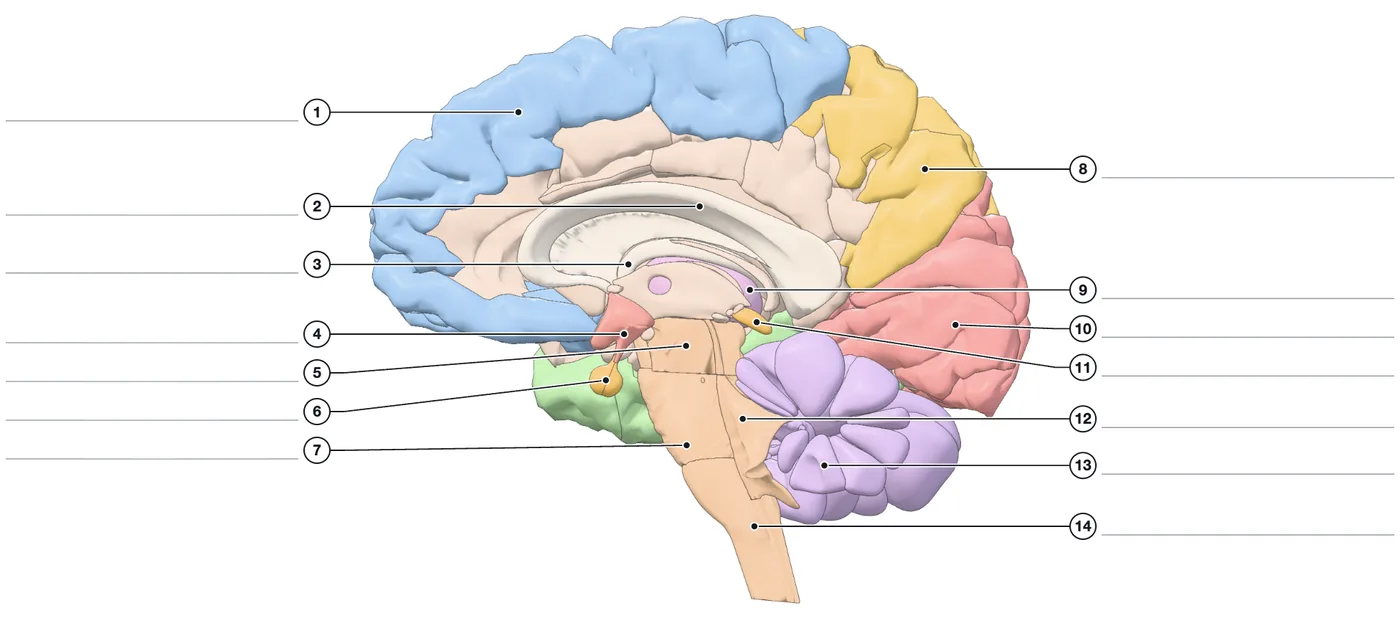
Word bank
0 of 14 placed
Drag a name onto its numbered line, or tap a name and then the line.
Your answers
- 1
- 2
- 3
- 4
- 5
- 6
- 7
- 8
- 9
- 10
- 11
- 12
- 13
- 14
3. Central and peripheral: two halves of one system
For all its complexity, the nervous system splits cleanly into two divisions. The central nervous system (CNS) is the brain and the spinal cord: the processing core where information is integrated and decisions are made - Cleveland Clinic: Central Nervous System. The peripheral nervous system (PNS) is everything else: the vast branching network of nerves that fans out from the spinal cord to reach every finger, organ, and patch of skin - Cleveland Clinic: Peripheral Nervous System. If the CNS is the headquarters, the PNS is the wiring and the field agents: it carries sensory reports in and command signals out.
The peripheral system then divides again by what it controls. The somatic branch handles the things you do on purpose: it carries sensation from your skin and sends the voluntary commands that move your muscles when you decide to wave, walk, or type. The autonomic branch handles everything you never think about: heart rate, digestion, sweating, pupil size, blood pressure - Cleveland Clinic: Autonomic Nervous System. You do not choose to digest your breakfast or widen your pupils in a dark room; the autonomic system does it for you, continuously, whether you are awake, asleep, or unconscious.
The autonomic system has two opposing branches that work like an accelerator and a brake:
- Sympathetic ("fight or flight"): speeds the heart, widens the airways, dumps sugar into the blood, and dilates the pupils to ready you for action or danger.
- Parasympathetic ("rest and digest"): slows the heart, stimulates digestion, and returns the body to a calm baseline once the threat passes.
These two are not on or off so much as constantly negotiating, and their balance shifts minute to minute. When you feel your heart pound before a big moment, that is your sympathetic branch flooring the accelerator; when you feel drowsy and warm after a large meal, that is your parasympathetic branch taking over to run digestion. This same autonomic system is what keeps the heart and the digestive system running without a single conscious command from you, which is one reason the nervous system touches every other guide in this library.
4. The brain, region by region
The brain is the crown of the central nervous system, and although it looks like a single wrinkled organ, it is really a stack of structures built up over evolutionary time, each layer taking on different work. Neuroanatomists group them into three broad parts: the huge cerebrum on top, the cerebellum tucked underneath at the back, and the brainstem running down the center to meet the spinal cord - NINDS: Know Your Brain. Each has a distinct job, and you can rotate the brain in the 3D explorer to see how they fit together in real space rather than as a flat drawing.
The cerebrum is the large, folded outer brain that most people picture when they hear the word "brain." It is split into two hemispheres, left and right, and each hemisphere is divided into four lobes, each with a broad specialty. The frontal lobe handles planning, decision-making, personality, and voluntary movement. The parietal lobe processes touch, temperature, and where your body is in space. The temporal lobe manages hearing, language, and memory. The occipital lobe at the very back is devoted almost entirely to vision - NINDS: Know Your Brain. The wrinkled surface is not random: those deep folds pack a large sheet of thinking tissue into a small skull, multiplying the available surface area.

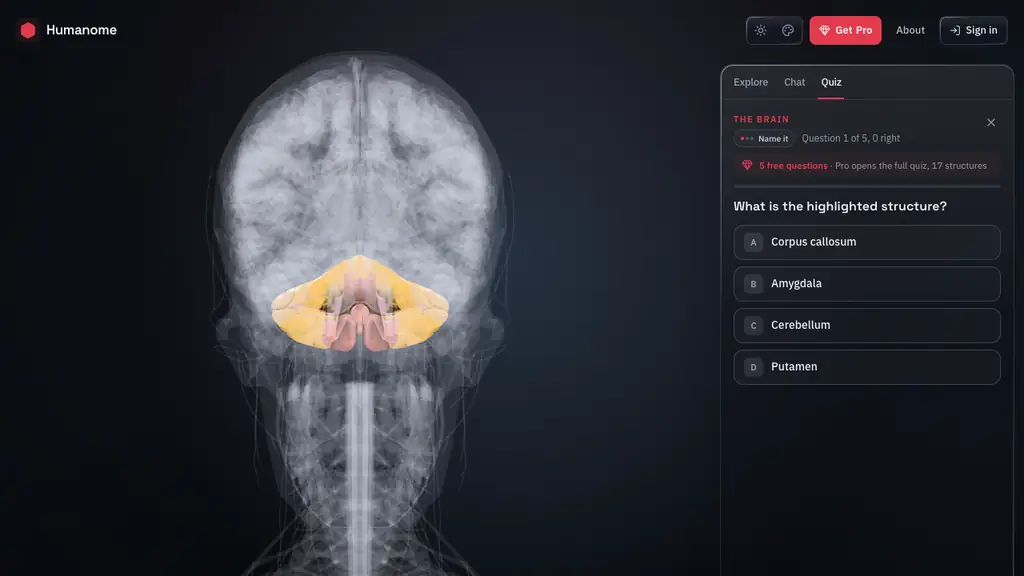
Below and behind the cerebrum sits the cerebellum ("little brain"). It does not decide what to do, it decides how smoothly to do it. The cerebellum fine-tunes balance, coordination, and precise movement, taking the cerebrum's rough intention ("reach for the cup") and turning it into a graceful, accurate motion instead of a clumsy lurch. When the cerebellum is impaired, a person can still move, but the movements become shaky and poorly timed. Robots have no cerebellum to turn "reach for the cup" into a smooth motion, so to teach one a new skill a person often moves a leader arm or a controller that the robot copies, and RobotTraining.jobs' guide to robot teleoperation, from the people behind Humanome, explains that work and how to start in it. The lowest tip of the cerebellum reaches down toward the brainstem, and one landmark there, the tonsil of the cerebellum, sits right at the opening where the brain meets the spinal cord, which is why it matters clinically when pressure builds inside the skull.
At the core runs the brainstem, the oldest and most vital part of the brain, made of three sections: the midbrain, the pons, and the medulla. The brainstem is the bridge that connects the brain to the spinal cord, and every signal traveling between your body and your thinking brain passes through it. More importantly, it runs the automatic survival functions: breathing, heart rate, blood pressure, swallowing, and the sleep-wake cycle. You can open the midbrain in 3D to see where this small but critical hub sits. This is the region that keeps your lungs breathing and your heart beating without a single conscious thought, day and night, which is why brainstem injuries are so dangerous: damage here can stop the very functions that keep a body alive.
5. The spinal cord and the reflex arc
If the brain is headquarters, the spinal cord is the main highway connecting it to the rest of the body. Running from the base of the brainstem down through the protective canal of the spine, the cord is a thick bundle of nerve fibers that carries nearly every signal traveling between the brain and the body below the neck - Cleveland Clinic: Central Nervous System. Sensory information (touch, pain, temperature, position) travels up the cord to the brain, and motor commands travel down it to the muscles. Damage to the cord can cut this highway, which is why a spinal injury can disconnect the brain from the parts of the body below the level of the break.
But the spinal cord is not just a passive cable. It can make certain decisions entirely on its own, without waiting for the brain, and the clearest example is the reflex arc. Imagine your hand touches a hot stove. If the pain signal had to travel all the way up to your brain, get processed, and travel all the way back down before you moved, you would burn badly in the delay. So the body uses a shortcut. Pain receptors in your skin fire a signal that races up a sensory nerve to the spinal cord, and right there, without any trip to the brain, the cord immediately fires a motor command back down to your arm muscles to yank your hand away. Only afterward does the "ouch" reach conscious awareness. Your hand is already moving before you have consciously felt the burn.
The reflex arc: your hand touches a hot stove → a pain receptor fires → the signal races up a sensory nerve → it reaches the spinal cord, which decides locally → a motor command shoots back down → your arm muscle contracts and the hand pulls away. Only afterward does a copy of the signal continue up to the brain, where you consciously feel the burn. Your hand is already moving before you feel it.
This is why a doctor tapping your knee with a small hammer makes your leg kick: the tap stretches a tendon, the sensory signal reaches the spinal cord, and the cord fires the muscle back automatically, no thought required. Reflexes are the nervous system's built-in fast lane for protection and stability, hardwired shortcuts that handle urgent situations faster than conscious thought ever could. They also give clinicians a quick window into whether the wiring between body, cord, and brain is intact, which is why reflex tests are part of almost every neurological exam. Every one of these commands ends at a muscle fiber that turns the signal into force, a partnership explained in How Your Muscles Work.
6. How the brain is protected and fed
The brain is the softest and most valuable tissue in the body, with the consistency of firm gelatin, so it is wrapped in an extraordinary set of defenses. The outermost is bone: the skull encases the brain and the vertebrae form a bony tunnel around the spinal cord. Inside the bone lie three protective membranes called the meninges, layered like the pages of a book to insulate and hold the delicate tissue in place - StatPearls: Cerebrospinal Fluid. When these membranes become infected and inflamed, the result is meningitis, which is exactly why that illness is taken so seriously.
Between two of those membranes floats one of the body's most elegant tricks: cerebrospinal fluid (CSF), a clear liquid that surrounds the brain and spinal cord. The brain literally floats in this fluid, which cushions it against jolts and lets its own weight rest gently rather than crushing its base. The body holds only about 125 to 150 mL of CSF at any moment, yet it continuously produces and reabsorbs roughly 500 mL per day, refreshing the entire volume several times over - StatPearls: Cerebrospinal Fluid. This constant renewal also flushes waste away from brain tissue, a kind of internal cleaning service running around the clock.
The brain has one more line of defense, this one chemical: the blood-brain barrier. The blood vessels feeding the brain are lined with unusually tight walls that act as a highly selective filter, letting in oxygen, glucose, and needed nutrients while blocking many toxins, pathogens, and stray molecules from reaching the neurons. This barrier is a large part of why the brain is so well protected from infection, and also, frustratingly, why delivering certain medicines to the brain is so difficult.
All that protection guards an organ with a huge appetite. The brain is only about 2% of body weight, but it consumes roughly 20% of the body's oxygen and energy at rest, more than any other organ for its size - Basic Neurochemistry, NCBI Bookshelf. Neurons cannot store fuel; they need a constant, uninterrupted delivery of oxygen and glucose from the blood. That dependence is the single most important fact for understanding stroke: if blood flow to a part of the brain is cut off, those neurons begin to die within minutes, because they have no reserve to fall back on. The brain's brilliance and its fragility come from the same source: it is a ravenous, non-stop organ that cannot pause even for a moment.
7. What can go wrong
Because the nervous system does so much, the ways it can fail are varied, and understanding them is far more empowering than fearing them. What follows is educational, not diagnostic: it explains what can go wrong and why, not what any individual has. Neurological and mental-health conditions are common, often treatable, and never a personal failing - MedlinePlus: Neurologic Diseases. It helps to group them by which part of the machine is affected: the blood supply, the electrical activity, the sensory processing, the slow loss of specific neurons, and the chemistry of mood.
The first group is vascular, and the most urgent is stroke. A stroke happens when the blood supply to part of the brain is either blocked by a clot (ischemic) or interrupted by a burst vessel (hemorrhagic), and starved neurons start dying within minutes. Stroke is one of the world's leading causes of death and long-term disability - WHO: Stroke. In the United States alone, more than 795,000 people have a stroke each year, roughly one every 40 seconds - CDC: Stroke Facts. You can watch a stroke light up the affected brain territory in the 3D model to see how a single blocked vessel silences a specific region, or read the full page on stroke.
Stroke is the clearest medical emergency in this whole guide, and it is worth memorizing the warning signs, summarized by the word FAST - CDC: Stroke Facts:
- F, Face drooping: one side of the face droops or feels numb; the smile is uneven.
- A, Arm weakness: one arm is weak or numb and drifts down when both are raised.
- S, Speech difficulty: speech is slurred, strange, or hard to understand.
- T, Time to call: if you see any of these, call emergency services immediately.
The reason to act instantly is biological: brain tissue dies by the minute, and treatments that dissolve a clot or stop a bleed work far better the sooner they are given. Every minute saved is brain tissue saved. If you ever see these signs in yourself or someone else, do not wait to see if they pass. Call for emergency help right away.
The second group is electrical. In epilepsy, the brain's normally orderly electrical signaling misfires into sudden, excessive bursts, producing seizures that can range from a brief lapse of awareness to full-body convulsions. Around 50 million people worldwide have epilepsy, making it one of the most common serious neurological conditions, and importantly it is often very treatable with medication - WHO: Epilepsy. You can explore how epilepsy relates to the brain in 3D to see it as a disorder of the brain's electrical rhythm rather than something mysterious.
The third group is sensory and pain, and the leading example is migraine. Far more than "a bad headache," migraine is a neurological disorder involving waves of abnormal activity across the brain and its blood vessels, often bringing throbbing pain, nausea, and sensitivity to light and sound. Headache disorders affect an enormous share of humanity, with migraine alone counted among the leading causes of years lived with disability worldwide - WHO: Headache Disorders. Seeing migraine in the 3D explorer helps reframe it as a genuine brain event, not a weakness or an overreaction.
The fourth group is degenerative, where specific neurons are gradually lost. In Parkinson's disease, the neurons that produce the neurotransmitter dopamine in a small brain region called the substantia nigra slowly die off, which is why the hallmark symptoms are movement-related: tremor, stiffness, and slowness. In 2019, more than 8.5 million people worldwide were living with Parkinson's, and the number is rising as populations age - WHO: Parkinson Disease. You can open Parkinson's disease in 3D to connect the symptoms to the specific circuitry involved, or read the full page on Parkinson's disease. Here the value of understanding the neuron pays off: Parkinson's is not the brain "wearing out" in general, it is the loss of one particular chemical messenger.
The final group is mood and mental health, and these are every bit as real and brain-based as the others. Depression and anxiety disorders involve genuine changes in brain chemistry and circuitry, not a lack of willpower or character. About 280 million people live with depression worldwide, and roughly 301 million with anxiety disorders, placing both among the leading causes of disability on Earth - WHO: Depression. Crucially, both are treatable, and reaching out for help is a medical step, not a moral one - NIMH: Depression. You can explore how depression and anxiety disorders relate to the brain in 3D, which can make these often-invisible conditions feel more concrete and less isolating. Many people now put these questions to an AI assistant first, which is why AI developers pay psychologists and counselors to review how a model handles mental-health conversations; the psychology roles on AITraining.jobs, from the same team that makes Humanome, show where that work is open.
The pattern across all of these is worth holding onto: conditions of the nervous system are common, they are understood far better than they once were, and most are treatable or at least manageable. Knowing which part of the machine is involved (the blood supply, the electrical rhythm, the sensory processing, a specific neurotransmitter, or the chemistry of mood) turns a frightening unknown into something you can name, discuss with a clinician, and act on.
8. Caring for your brain and nervous system
The good news buried inside all this biology is that the brain is not a fixed, declining organ. It is a living, adaptable network that responds to how you treat it, through a property called neuroplasticity, its lifelong ability to rewire and strengthen connections. Much of what protects the brain is the same everyday care that protects the heart and blood vessels, because the brain depends utterly on that blood supply - MedlinePlus: Neurologic Diseases. None of the habits below is a prescription or a cure, they are general, evidence-aligned ways to give your nervous system its best shot.
A few of the strongest levers are refreshingly ordinary:
- Sleep well: the brain uses sleep to consolidate memory and clear metabolic waste, so consistent, sufficient sleep is protective rather than optional.
- Move your body: regular physical activity improves blood flow to the brain and supports mood, memory, and long-term brain health.
- Protect your blood vessels: managing blood pressure, blood sugar, and cholesterol is one of the most direct ways to lower stroke risk.
- Keep learning and connecting: mentally engaging activity and strong social ties help build cognitive resilience over a lifetime.
- Protect your head: seat belts, helmets, and fall prevention guard against the injuries the brain cannot easily repair.
Notice how many of these overlap with cardiovascular health. Because the brain consumes so much oxygen and glucose delivered by the blood, anything that keeps your arteries clear and your blood pressure in a healthy range directly protects your brain, which is a good reason to read the companion guide on how the heart works. Even the skeleton plays a protective role, since the skull and vertebrae are the hard armor around the entire central nervous system, and your skin is the vast sensory sheet feeding touch and temperature data back to it.
Beyond daily habits, the single most useful thing you can do for your brain is to take symptoms seriously and seek care early. The sudden warning signs of stroke are a call-now emergency, as described above. But slower changes matter too: a persistent change in mood, memory, movement, or sensation is worth discussing with a clinician rather than dismissing. Mental-health symptoms deserve exactly the same attention as physical ones, because they arise from the same organ - NIMH: Depression. Caring for your nervous system is not about fear, it is about giving the most remarkable system in your body the respect it has earned.
9. Explore it yourself
You have just traveled from a single firing neuron all the way up to a thinking, feeling, self-repairing brain, and out along the nerves to every corner of the body. The best way to make it stick is to stop reading about it and start turning it in your hands. Open Humanome, the 3D explorer, rotate the model, and peel it down to the nervous layer to see the brain, spinal cord, and nerves as one continuous, connected network rather than a set of separate parts.
From there, follow your curiosity. Click into the midbrain to find the small brainstem hub that helps keep you breathing, or open the tonsil of the cerebellum to see the structure sitting right at the junction of brain and spinal cord. Then search the conditions and watch them light up on the exact anatomy they affect: see a stroke strike a brain territory, epilepsy as a disorder of electrical rhythm, or Parkinson's tied to its specific circuitry. Seeing a condition mapped onto real 3D anatomy is a very different kind of understanding than reading its name in a list, and it is exactly what Humanome was built to make possible for anyone. If you prefer to read first, each has its own reference page: stroke, epilepsy, migraine, and Parkinson's disease, and you can browse the nervous system as a whole.
The takeaway
Your nervous system is a single, breathtaking network: 86 billion neurons passing electrical and chemical signals along insulated wires, organized into a central command core (brain and spinal cord) and a peripheral web reaching every part of you. The cerebrum thinks, the cerebellum coordinates, the brainstem keeps you alive, and the spinal cord carries it all while running life-saving reflexes on its own. It is fragile, hungry, and superbly protected, and it responds to how you care for it. Understanding it, region by region and cell by cell, is the first step to protecting it, and now you can see the whole thing in three dimensions whenever you like.
This article is general education, not medical advice. It cannot diagnose or treat any condition. If you have concerns about your own health, or you notice sudden warning signs like those of a stroke, contact a qualified clinician or emergency services right away.