How Your Kidneys Work
· 27 min read · Humanome
A clear, visual tour of the two quiet organs that clean your blood, balance your fluids, and set your blood pressure.
Your kidneys filter about 150 quarts of blood every single day, roughly 40 gallons, and return almost all of it to your body while sending only about 1 to 2 quarts out as urine - NIDDK, Your Kidneys and How They Work. They do this without a break, without your attention, and usually without any warning when something starts to go wrong. That silence is exactly why kidney disease is so common and so often missed: about 35.5 million US adults, roughly 1 in 7, are estimated to have chronic kidney disease, and around 9 in 10 of them do not know it - CDC, Chronic Kidney Disease Basics.
This guide is a calm, careful tour of what these two fist-sized organs actually do, why blood needs constant cleaning, and how a microscopic filter called the nephron pulls it off. Along the way you can open the live 3D model. Humanome is an interactive 3D explorer of the body, and the kidneys and urinary tract are structures you can click into and light up. Watch for the links: they open the exact part discussed.
Contents
- The problem the kidneys solve: why blood needs cleaning
- Two bean-shaped filters and where they sit
- The nephron: filter, then take almost everything back
- Beyond waste: the kidney as a control panel
- Blood pressure, red cells, and vitamin D
- The urinary tract: ureters, bladder, and urethra
- Urinary tract infections
- Kidney stones
- Chronic kidney disease and its two leading causes
- How to protect your kidneys
- See it in 3D and keep exploring
- The takeaway
1. The problem the kidneys solve: why blood needs cleaning
Every cell in your body is a tiny chemical factory, and like any factory it produces waste. As cells burn fuel and build and break down proteins, they release byproducts (urea, creatinine, excess acid, surplus salts) straight into the bloodstream. Blood is the body's delivery service, carrying oxygen and nutrients everywhere, but that means it also picks up everything the cells throw out. Left alone, those wastes would build up in the blood within hours and poison the very cells the blood is meant to feed.
So the body needs a way to continuously clean the blood, pulling out what is harmful while keeping what is useful. That is the core job of the kidneys. They are the body's filtration plant, sampling the blood minute after minute, extracting waste and surplus, and packaging it as urine to be flushed away. If the heart is the pump and the lungs are the gas exchanger, the kidneys are the purification and balance system, and they are just as essential. A person can live a normal life with one kidney, but a body cannot survive long with none.
What makes the kidneys remarkable is not just that they remove waste, but how selective they are about it. A crude filter would strain out the bad and lose the good in the same pass. The kidneys instead run a two-step trick: they filter an enormous volume of blood indiscriminately, then reclaim almost everything valuable and let only the true waste and the right amount of water leave. That is why they can process 150 quarts of blood a day yet produce only 1 to 2 quarts of urine - NIDDK, Your Kidneys and How They Work. Hold that idea (filter big, take almost everything back) because it is the single concept that makes the rest of this guide make sense.
The kidneys never do this job alone. The heart pushes the blood to them under pressure, and the amount of that pressure is something the kidneys themselves help set, a two-way relationship we return to later. If you want to see how that pump keeps blood moving, our companion guide on how the human heart works picks up that thread. For now, the takeaway is simple: dirty blood in, clean blood out.
2. Two bean-shaped filters and where they sit
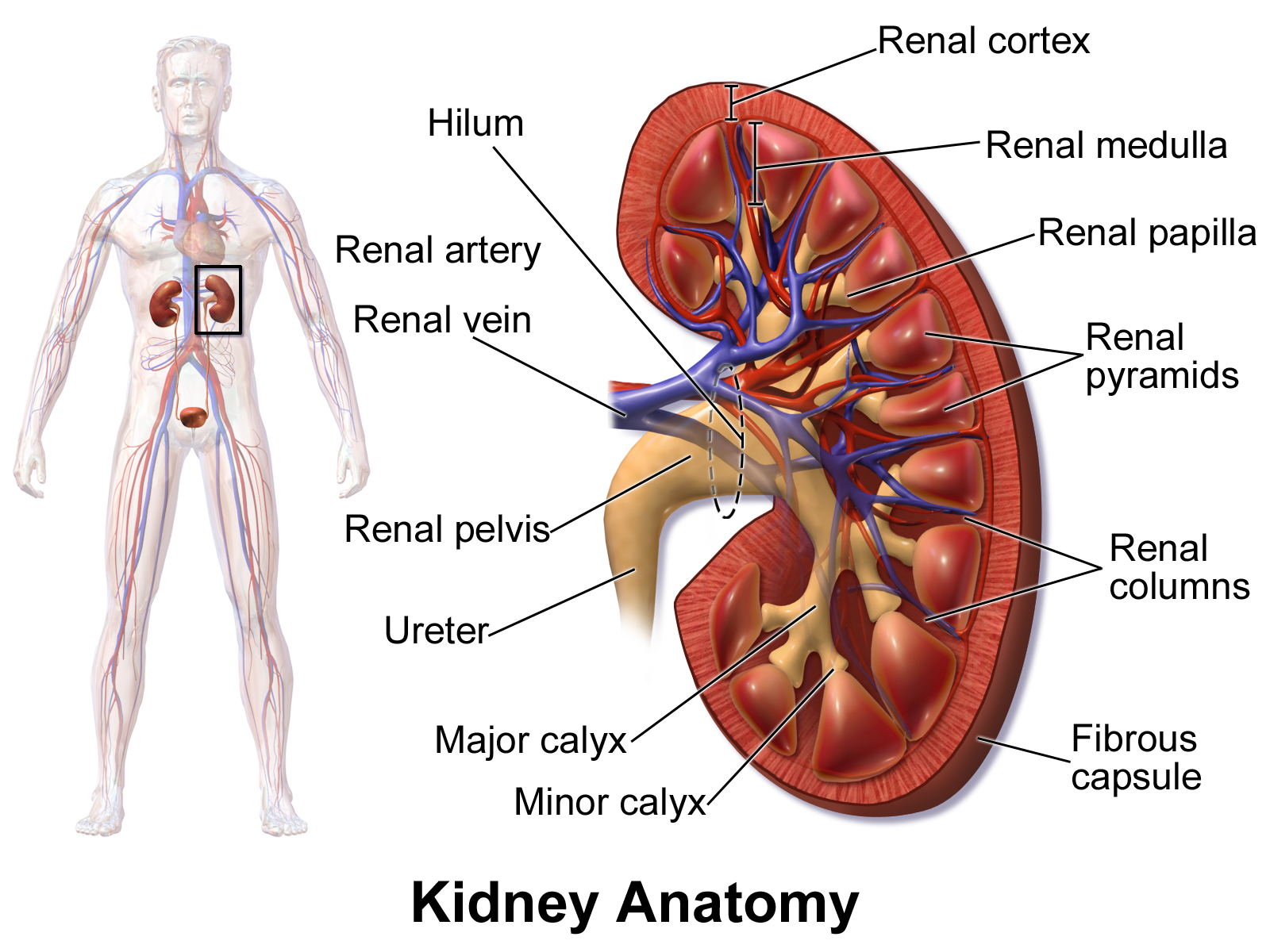
You have two kidneys, one on each side of your spine, tucked just below the rib cage toward your back. Each one is a bean-shaped organ about the size of a fist, roughly 4 to 5 inches long, and together they weigh only a few ounces yet handle the entire blood-cleaning load of the body - NIDDK, Your Kidneys and How They Work. They sit higher and further back than most people expect: not down at belt level, but up under the lower ribs, which is why kidney pain is often felt in the flank or the mid-back rather than the front of the belly. You can open the left kidney and the right kidney in the model to see exactly where they nestle against the back wall of the abdomen.
Because they are the body's filter, the kidneys demand an outsized share of the blood supply. Blood arrives through the renal artery, a large branch off the body's main artery, and at rest the two kidneys together receive roughly a fifth of everything the heart pumps. Cleaned blood leaves through the renal vein and rejoins the circulation, while the extracted waste and surplus water drain downward as urine.
Slice a kidney open and it has a clear structure. The outer layer is the cortex, the inner region is the medulla (arranged into cone-shaped pyramids), and everything drains toward a central collecting space called the renal pelvis, which funnels urine into the tube that carries it away. That central funnel is the transition point where the kidney stops being a filter and becomes the top of the urinary tract. The kidneys are part of the broader group of internal organs the model lets you explore, and you can browse the whole set in the organs system view to see how they sit among the liver, gut, and other structures.
The arrangement of two kidneys is a piece of quiet engineering wisdom: redundancy. Losing one kidney to injury, donation, or disease still leaves a fully functional filter, and the remaining one typically grows and takes on much of the missing kidney's work. Very few of the body's jobs are duplicated this way, which tells you how essential the filtering function is.
3. The nephron: filter, then take almost everything back
Zoom in far enough and each kidney turns out to be a bundle of about a million microscopic filtering units called nephrons - NIDDK, Your Kidneys and How They Work. The nephron is where the real work happens, and it is the single most important structure to understand in the whole system. Every one of those million units carries out the same two-step process, in parallel, continuously, and their combined output is what leaves your body as urine. Understand one nephron and you understand the kidney.
Each nephron has two main parts. The first is the glomerulus, a tiny tuft of leaky blood vessels acting as the initial sieve. Blood under pressure pushes against these vessel walls, and water plus small dissolved molecules (salts, sugar, urea, and other little passengers) squeeze through into a surrounding cup, while blood cells and large proteins are too big to pass and stay behind in the blood. This is filtration, and it is deliberately indiscriminate: the glomerulus does not sort good from bad, it simply strains everything small out of the blood at once. The fluid it produces, called filtrate, is essentially blood plasma minus the big stuff.
The second part is the tubule, a long, winding tube that the filtrate then travels through, and this is where the selectivity comes in. As the filtrate flows along the tubule, the surrounding blood vessels reabsorb almost all of the water, along with the minerals and nutrients the body wants to keep, pulling them back into the bloodstream - NIDDK, Your Kidneys and How They Work. Useful things like glucose and most of the sodium are reclaimed; genuine waste like urea is largely left behind. The tubule also actively secretes a few extra wastes and surplus acid into the fluid to be dumped. What survives this reclaim-and-dump journey to the end of the tubule is urine.
The arithmetic of this is the punchline of the whole guide, and it is worth stating plainly. Across all million nephrons per kidney, filtration produces roughly 180 liters (about 150 quarts) of filtrate a day, an astonishing volume, close to your entire blood plasma cycled through the filters dozens of times over. Yet reabsorption reclaims about 99% of the water, so only around 1 to 2 quarts ever leaves as urine - NIDDK, Your Kidneys and How They Work. Here is the whole nephron process in one line:
One trip through a nephron: blood enters the glomerulus under pressure, water and small molecules are filtered out into the tubule, the tubule reabsorbs nearly all the water and the useful minerals back into the blood, a little extra waste and acid is secreted in, and what remains at the end (a tiny, concentrated fraction) drains away as urine.
The reason for this seemingly wasteful design (filter a huge volume, then reclaim almost all of it) is control. By pouring so much through the filter and then deciding molecule by molecule what to take back, the kidney gets fine-grained command over the exact makeup of your blood. Drink a lot of water and the tubules reabsorb less, so you make more, paler urine; get dehydrated and they reabsorb more, so you make less, darker urine. The filter is fixed and blunt, but the reabsorption step is a tunable dial that keeps your internal chemistry in a narrow, healthy range.
4. Beyond waste: the kidney as a control panel
It is tempting to think of the kidneys as just a drain, but that badly undersells them. Removing waste is only the most obvious job. The deeper role of the kidney is to keep the internal environment of your body (its water content, its salt levels, its acidity) inside the narrow band your cells need to function. Physiologists call this homeostasis, and the kidneys are one of its central regulators. Every sip of water, salty snack, and hard workout nudges your blood chemistry, and the kidneys quietly correct it.
Start with fluid balance. Your body is mostly water, and the total amount has to stay remarkably stable: too little and blood pressure falls and cells shrivel, too much and tissues swell and the heart is overworked. The kidneys are the master valve on body water. By deciding how much of that filtered fluid to reabsorb versus release, they set your urine volume from minute to minute, holding on to water when you are dry and letting it go when you have plenty. That is the same water dial you watched in the nephron, now doing its real job.
Then there are the electrolytes, the dissolved minerals like sodium, potassium, calcium, and phosphorus that carry electrical charge and run everything from nerve signals to heartbeats. The kidneys maintain a healthy balance of these salts and minerals in the blood, reabsorbing what is needed and excreting the surplus - NIDDK, Your Kidneys and How They Work. Potassium is a vivid example: too much or too little can disturb the heart's rhythm, and the kidney keeps it in a tight window. This is one reason kidney failure is so dangerous, because when the filters fail, these electrolytes drift out of range and the whole body feels it.
The kidneys also manage acid-base balance, the blood's pH. Cells constantly produce acid as they work, and blood has to stay slightly alkaline within a very tight range or proteins throughout the body stop working properly. The kidneys remove the acid produced by the cells, excreting it in the urine and adjusting the blood's buffering capacity - NIDDK, Your Kidneys and How They Work. They share this task with the lungs, which blow off acid as carbon dioxide, so breathing and kidney function work together to hold your pH steady. The lungs handle fast, minute-to-minute corrections and the kidneys handle the slower, more precise ones, a partnership you can read more about in our guide to how your lungs work.
5. Blood pressure, red cells, and vitamin D
Beyond cleaning and balancing, the kidneys are also an endocrine organ, meaning they release hormones that act on distant parts of the body. Three of these are worth knowing, because they explain why kidney trouble shows up in places that seem to have nothing to do with urine: your blood pressure, your energy levels, and your bones.
The first is blood pressure control. When the kidneys sense that pressure or blood volume is dropping, they release an enzyme called renin, which kicks off a hormone cascade that tightens blood vessels and tells the body to hold on to salt and water - Cleveland Clinic, Kidney. Both effects raise blood pressure back toward normal. This is enormously useful when you are dehydrated or bleeding, but it is also why the kidneys and blood pressure are so tightly bound: a diseased kidney can misread the situation and push blood pressure too high, and chronically high pressure in turn damages the delicate filters. The two feed each other, which is exactly why hypertension is both a cause and a consequence of kidney disease. You can watch hypertension light up the vessels it strains in the explorer to see how far its reach extends, and our guide on how the human heart works explains the pressure side of the loop in detail.
The second hormone is erythropoietin, often shortened to EPO. The kidneys sense the oxygen level in the blood, and when it runs low they release erythropoietin, which travels to the bone marrow and tells it to make more red blood cells - Cleveland Clinic, Kidney. Red cells carry oxygen, so this is the body's way of ramping up oxygen-carrying capacity when it is needed. It also explains a classic symptom of kidney failure: as the kidneys decline, they make less erythropoietin, the marrow makes fewer red cells, and the person develops anemia and the deep fatigue that comes with it. If a filtering organ can leave you tired and pale, this hormone is why. You can explore anemia in the model to see the whole-body reach of a low red-cell count.
The third job is activating vitamin D. The vitamin D you get from sunlight and food is inactive until the kidneys perform the final chemical step that switches it on, producing the active form (calcitriol) that lets your gut absorb calcium and keeps your bones strong - Cleveland Clinic, Kidney. This links the kidneys directly to your skeleton, which is why long-standing kidney disease can weaken bones over time. It is a reminder that these organs are not isolated drains but hubs wired into the rest of the body, a theme that runs through our guide to the endocrine system and hormones, where the adrenal glands that sit directly on top of the kidneys add another layer of fluid and salt control through hormones like aldosterone and ADH.
6. The urinary tract: ureters, bladder, and urethra
Making urine is only half the story. Once the kidneys have produced it, that fluid has to be collected, stored, and released on a schedule that suits daily life, and that is the job of the rest of the urinary tract. Think of the kidneys as the treatment plant and the urinary tract as the drainage and storage system that carries the output away and lets it out at a convenient time rather than in a constant dribble.
Urine leaves each kidney through a ureter, a thin muscular tube about the width of a drinking straw that runs down from the kidney to the bladder - Cleveland Clinic, Kidney. The ureters do not rely on gravity alone; their walls squeeze in rhythmic waves to push urine downward, the same wave-like muscle action (peristalsis) that moves food through the gut. There are two of them, one per kidney, and they empty into the bladder low down, entering at an angle that acts like a one-way flap so urine does not wash back up toward the kidneys.
The bladder is a hollow, muscular, balloon-like organ that stores urine until you are ready to release it. Its walls are stretchy and folded when empty, and they smooth out and expand as it fills, comfortably holding a couple of cups of urine while sending your brain a gentle, then insistent, signal that it is time to go. When you urinate, the bladder wall contracts and the urine exits through the urethra, the final tube to the outside. This storage-and-release design is why you are not tethered to a toilet: the bladder buffers a continuous trickle into occasional, voluntary emptying.
This last stretch of plumbing is where anatomy matters for health, because the urethra is the doorway through which the otherwise sterile urinary tract can be reached from the outside. A crucial difference between the sexes lives here: the female urethra is much shorter than the male one and its opening sits closer to the rectum, which gives bacteria a shorter, easier path inward. That single anatomical fact explains most of what we cover next, and why women are affected far more often - NIDDK, Bladder Infection (UTI) in Adults. The fluid-and-nutrient handling that fills the bloodstream the kidneys clean starts much earlier, in the gut, which our guide to the digestive system explained walks through.
7. Urinary tract infections
A urinary tract infection, or UTI, is what happens when bacteria get into the normally sterile urinary tract and multiply. Most begin in the bladder (a bladder infection is called cystitis) when bacteria travel up the urethra, and the usual culprit is E. coli, a bacterium that lives harmlessly in the gut but causes trouble when it reaches the wrong place - NIDDK, Bladder Infection (UTI) in Adults. Understanding a UTI as bacteria moving upstream against the outward flow of urine makes both its symptoms and its prevention intuitive.
UTIs are strikingly common, and the anatomy from the last section is the reason. Because the female urethra is short and close to sources of gut bacteria, women are far more affected: more than half of women will have at least one UTI in their lifetime, and women develop them many times more often than men - NIDDK, Bladder Infection (UTI) in Adults. Recurrence is common too, with a sizable share of women getting another infection within months of the first. This is not a sign of poor hygiene or bad luck; it is largely a matter of how the plumbing is built.
The symptoms follow directly from an inflamed, irritated bladder and urethra. A typical bladder UTI causes a burning feeling when urinating, a frequent and urgent need to go even when little comes out, and sometimes cloudy or strong-smelling urine or a dull ache low in the belly. These are uncomfortable but usually not dangerous when caught early, and a short course of antibiotics typically clears a straightforward bladder infection. You can see a urinary tract infection in the model to place the affected structures, and read the urinary tract infection condition page for more detail.
The reason a UTI deserves attention is what happens if it is ignored. Bacteria can climb further up the ureters and reach the kidneys themselves, causing a kidney infection (pyelonephritis) that is more serious and can bring fever, back or flank pain, and nausea. An untreated kidney infection can damage the kidneys or spread to the blood, so it needs prompt care. The practical rule is simple: do not wait out urinary symptoms that are worsening, and seek care promptly if a suspected UTI comes with fever, back pain, or vomiting.
8. Kidney stones
A kidney stone is a hard, pebble-like mass that forms inside a kidney when certain minerals in the urine become too concentrated and crystallize out of solution instead of staying dissolved. Most stones are made of calcium compounds (calcium oxalate is the most common), with the rest made of uric acid or other substances - NIDDK, Kidney Stones: Definition and Facts. The mental model is straightforward: when urine gets too concentrated, its dissolved minerals run out of room and start clumping into solid crystals, exactly the way sugar crystallizes out of a syrup that is too saturated.
Kidney stones are common and becoming more so. About 11 percent of men and 6 percent of women in the United States will have a kidney stone at least once in their lifetime, and rates are rising - NIDDK, Kidney Stones: Definition and Facts. A small stone may sit silently in the kidney and cause no trouble at all, sometimes passing unnoticed. The problem comes when a stone moves into a ureter, the narrow tube to the bladder, and gets stuck. Then it blocks the flow of urine and stretches the tube, which produces some of the most severe pain in all of medicine, often felt in waves in the flank or lower belly, sometimes with blood in the urine or nausea.
Many small stones eventually pass on their own with time, pain control, and plenty of fluids, while larger ones that will not pass may need a procedure to break them up or remove them. But the more useful part for most people is prevention, because the single biggest controllable risk factor is being under-hydrated. You are more likely to develop a stone if you do not drink enough liquid, because low fluid intake leaves the urine concentrated and primed to crystallize - NIDDK, Kidney Stones: Definition and Facts. Drinking enough to keep the urine dilute is the simplest, most effective defense there is. You can explore kidney stones in 3D to see where they form and lodge, and the kidney stones condition page covers the types and triggers in more depth.
Once you have had a stone, your odds of another go up, which makes prevention personal rather than abstract. Beyond fluids, adjustments to diet (moderating sodium and, for some stone types, certain foods) can lower the risk. But the through-line is the same as everywhere else in this guide: keep the urine dilute and flowing, and you keep the crystals from ever getting started.
9. Chronic kidney disease and its two leading causes
Chronic kidney disease (CKD) is the slow, long-term loss of the kidneys' filtering ability, and it is far more widespread than most people realize. About 35.5 million US adults, roughly 1 in 7, are estimated to have it, and about 9 in 10 of those adults do not know they have it - CDC, Chronic Kidney Disease Basics. That unawareness is the whole tragedy of the disease. Damaged kidneys usually cause no symptoms in the early stages, so the filters can quietly lose a large fraction of their capacity before anything feels wrong, and by the time symptoms appear the damage is often advanced and permanent.
The two leading causes are not exotic. Diabetes and high blood pressure together account for about 2 out of 3 new cases of kidney failure in the United States - CDC, Chronic Kidney Disease Basics. Both work by damaging the tiny, high-pressure blood vessels of the glomeruli, the filtering tufts we met earlier. In diabetes, chronically high blood sugar injures those delicate vessels over years. In hypertension, the relentless force of high pressure batters them. Because both conditions are themselves common and often silent, they do their damage to the kidneys without the person noticing on either front. You can examine type 2 diabetes and hypertension in the explorer to see the systems they quietly strain. Where diabetes and kidney disease meet, GLPcompare sets out what each GLP-1 label says on chronic kidney disease and what the largest trials found; it is a sister site to Humanome.
The scale of these upstream causes is worth pausing on. Nearly half of US adults, about 48% (roughly 120 million people), have high blood pressure - CDC, High Blood Pressure Facts. That enormous pool of hypertension is the reservoir from which much kidney disease is drawn. Combine it with the millions living with diabetes and it becomes clear why CKD is so common, and why controlling those two conditions is the most powerful thing anyone can do for their kidneys. The chart below shows how directly the leading causes of new kidney failure trace back to these familiar diseases.
As CKD advances, the consequences ripple outward through everything the kidneys control. Waste builds up in the blood, fluid and electrolytes drift out of balance, blood pressure climbs, red-cell production falls (bringing anemia and fatigue), and bones weaken as vitamin D activation drops. In its final stage, kidney failure, the kidneys can no longer keep a person alive on their own, and treatment requires dialysis (a machine that filters the blood) or a transplant. Every day about 360 people in the US begin dialysis for kidney failure - CDC, Chronic Kidney Disease Basics. The dialyzer at the heart of that machine is a membrane separation device, the kind of process chemical engineers design, and AI labs pay chemical engineers by the hour to grade a model's process and materials reasoning, so the chemical engineering roles on AITraining.jobs, a careers site with the same owners as Humanome, are worth a look for anyone in that field. Kidney disease has become serious enough at the population level that it rose to the ninth leading cause of death in the United States in 2022 - CDC/NCHS, Mortality in the United States, 2022. You can see kidney disease in the model and read the fuller kidney disease condition page to understand which structures it involves.
10. How to protect your kidneys
The reassuring flip side of all those numbers is that the biggest drivers of kidney disease are preventable and manageable, and the habits that protect your kidneys are the same ones that protect your heart and the rest of your body. Because early kidney disease has no symptoms, the most important single step is not a treatment at all but awareness: getting tested is often the only way to know your kidneys are healthy, especially if you have diabetes, high blood pressure, or a family history - NIDDK, Preventing Chronic Kidney Disease.
The two most powerful levers are the flip side of the two leading causes. Keeping blood pressure in a healthy range takes the constant battering off the glomeruli, and keeping blood sugar controlled protects those same vessels from the slow damage of diabetes. Everything else in kidney protection supports these two goals. The good news is that ordinary, unglamorous habits move both dials at once, and none of them require anything exotic. Here are the levers that matter most:
- Control blood pressure and blood sugar. These two conditions cause most kidney failure, so managing them is the single biggest protection.
- Go easy on salt. Aim for less than 2,300 mg of sodium a day, since excess sodium makes the body retain fluid and raises blood pressure - NIDDK, Preventing Chronic Kidney Disease.
- Stay hydrated. Enough fluid keeps urine dilute and flowing, lowering the risk of stones and infections.
- Eat for your whole body. Plenty of fruit, vegetables, and whole grains, less processed food and added sugar, following patterns like the DASH plan.
- Move most days. About 30 minutes of activity on most days helps control blood pressure, blood sugar, and weight.
Two of those deserve a closer look because they are so often underrated. Salt matters more than people think: sodium controls how much fluid your body holds, and too much of it makes blood retain water, which raises blood pressure and puts stress on both the kidneys and the heart - NIDDK, Preventing Chronic Kidney Disease. And hydration is the quiet hero of the whole system: keeping the urine dilute is the simplest defense against both kidney stones and infections, and it costs nothing. You do not need to force gallons of water; you need to drink enough that your urine stays pale rather than dark.
The habits above are not a burden invented for kidney health; they are the same core habits that protect nearly every organ. Blood pressure control, blood sugar control, a sensible diet, movement, and enough water are the shared foundation, which is why one good routine defends the whole body at once. The kidneys, silent as they are, reward that care by doing their job for a lifetime without ever asking for your attention.
11. See it in 3D and keep exploring
Reading about the kidneys is one thing. Turning them over in your hands is another. Everything described in this guide (the two bean-shaped filters tucked under the ribs, the ureters carrying urine down to the bladder, the whole quiet drainage system) is waiting for you in the live model. This is exactly what Humanome was built for: to make the body explorable by anyone, with no medical training required.
Start at the explorer home and find the kidneys against the back wall of the abdomen. Click the left kidney and the right kidney to see the pair in place, and browse the surrounding structures in the organs system view. Then search any of thousands of conditions and watch the exact structures they affect light up: a urinary tract infection, kidney stones, chronic kidney disease, or the upstream drivers hypertension and type 2 diabetes. Seeing which parts a condition touches makes the mechanism stick in a way words alone cannot.
The kidneys do not work alone, and neither should your exploration of the body. Because blood pressure and kidney function are so tightly linked, read how the human heart works next to see the pump side of that loop. The fluid and nutrients that fill the blood the kidneys clean are absorbed in the gut, covered in the digestive system explained. And the adrenal glands that sit directly on top of the kidneys add hormonal control over salt and water, part of the story in the endocrine system and hormones. Each system connects to the kidneys, and the explorer lets you move between them freely. You can also open the crawlable condition pages for kidney disease, kidney stones, urinary tract infection, hypertension, and type 2 diabetes to read each one in depth.
12. The takeaway
Strip away the anatomy and the kidneys are a single, elegant idea: two small filters that clean your blood by a two-step trick, filtering a huge 180 liters a day and then reabsorbing almost all of it, so only a concentrated 1 to 2 quarts leaves as urine. But they are far more than a drain. They balance your body's water, salts, and acidity, and they release hormones that set your blood pressure, spur your red blood cell production, and switch on vitamin D for your bones. Nearly everything that goes wrong (an infection climbing the tract, a stone crystallizing from concentrated urine, the slow erosion of filtering power from diabetes and high blood pressure) makes sense once you understand that core machine. And nearly everything that protects them comes down to a few honest habits: control your pressure and sugar, go easy on salt, drink enough water. Now you can see it working in 3D.
This article is for general education, not medical advice. It cannot diagnose or treat any condition. If you have concerns about your kidneys or your health, or you notice warning signs like severe flank pain, blood in your urine, or a fever with back pain, please consult a qualified clinician, and in an emergency call your local emergency number right away.