How Your Muscles Work
· 25 min read · Humanome
A clear tour of the tissue that moves you, beats your heart, and quietly runs your gut.
Muscle makes up roughly 30% to 40% of your body mass, more than any other single tissue, and you own more than 600 of them working around the clock - Cleveland Clinic, Muscle. Some obey you: they lift a cup, climb a stair, shape a smile. Others never ask your permission at all. Your heart squeezes about 100,000 times a day without a single conscious command, and the muscle lining your gut pushes breakfast along while you think about something else entirely. This guide is a calm, careful look at how all of that actually works.
The core idea is simpler than the biology textbooks make it sound: a muscle is a machine that turns chemical energy into movement. It shortens when told to, and everything else, the three types, the wiring, the fuel, the way muscle grows and fades, follows from that one job. Throughout, you can open the live 3D model and see these structures in place. Humanome is an interactive 3D explorer of the body, and the muscular system is one of the layers you can peel back and study. Watch for the links: they light up the exact system being discussed.
Contents
- What a muscle actually is
- The three muscle types
- Skeletal muscle: how you move on command
- The sliding-filament trick: how contraction happens
- Motor units: how the nervous system commands movement
- Fueling the machine: aerobic, anaerobic, and fatigue
- Cardiac and smooth muscle: the tissue you never think about
- How muscle adapts: training and hypertrophy
- How muscle declines: disuse and age
- How to keep your muscle healthy
- See it in 3D and keep exploring
- The takeaway
1. What a muscle actually is
Strip away the anatomy and a muscle is a single, elegant device: a bundle of specialized cells that can shorten on demand. That is the whole trick. Muscle cells are the only cells in your body built to contract, to pull their two ends closer together with real force, and every movement you have ever made, from a marathon to a blink to a heartbeat, is some arrangement of cells doing exactly that. Because a muscle can only pull, never push, the body always works muscles in opposing teams: one shortens to bend a joint, another shortens to straighten it back out.
That pulling force does not come from nowhere. A muscle is fundamentally an energy converter, taking the chemical energy stored in a molecule called ATP (adenosine triphosphate) and turning it into physical motion and heat. This is why hard exercise makes you warm and why shivering, which is just rapid involuntary muscle twitching, warms you up on a cold day. Muscle is one of the body's furnaces as much as its engine, and it burns fuel whether you are sprinting or sitting still.
The scale of it is easy to overlook. Skeletal muscle alone holds a large share of the body's total protein and is one of its most metabolically active tissues, which is part of why keeping muscle matters far beyond looking strong - StatPearls, Physiology of Skeletal Muscle. To see where all this tissue sits, you can open the muscular system in the explorer and view the layer that wraps almost the entire skeleton. From there the rest of this guide is just detail: what kinds of muscle you have, how they contract, how they are commanded, and how they change over a lifetime.
2. The three muscle types
Your body does not use one muscle for everything. It uses three distinct types, each tuned for a completely different job, and telling them apart is the single most useful thing to understand about muscle. The differences come down to two questions: do you control it consciously, and does it look striped or smooth under a microscope. Answer those two questions and every muscle in your body sorts cleanly into one of three bins - Cleveland Clinic, Skeletal Muscle.
The first type is skeletal muscle, the muscle you think of when you think "muscle." It attaches to your bones, it moves your skeleton, and crucially it is voluntary: you decide when your bicep flexes or your foot steps. Under a microscope its fibers look striated, banded with regular stripes, because their internal machinery is packed in orderly rows. Skeletal muscle is the most abundant type in the body and the star of most of this guide.
The second type is cardiac muscle, and it exists in exactly one place: the wall of your heart. It is also striated, like skeletal muscle, but unlike skeletal muscle it is involuntary and, remarkably, it never tires. The third type is smooth muscle, which lines the hollow organs: your gut, your blood vessels, your airways, your bladder. It is involuntary and, true to its name, it is not striated, appearing smooth and uniform. Here are the three side by side:
- Skeletal muscle: voluntary, striated, attached to bone, moves the body.
- Cardiac muscle: involuntary, striated, found only in the heart, never rests.
- Smooth muscle: involuntary, not striated, lines the gut, vessels, airways, and bladder.
That three-way split is the map for everything that follows. The voluntary muscle you command, the tireless muscle that pumps your blood, and the quiet muscle that runs your plumbing are built from related parts but assembled for very different lives. We will take skeletal muscle first, because it is the one you can feel yourself, and because its contraction machinery is the clearest window into how all muscle turns fuel into force.
3. Skeletal muscle: how you move on command
Skeletal muscle is the tissue that lets you act on the world. Every deliberate motion, walking, gripping, chewing, speaking, even the fine work of your eyes tracking this line of text, is skeletal muscle contracting under the direction of your will. It makes up the bulk of your body's muscle and, because you build and lose it based on how you live, it is the type most in your hands. Skeletal muscle also does quieter work you rarely credit it for: it holds your posture against gravity all day, and its constant low-level activity generates much of your resting body heat.
The architecture is a nested bundle, which is worth picturing because it explains how muscle generates such force. A whole muscle is a bundle of smaller bundles called fascicles, each fascicle is a bundle of long cells called muscle fibers, and each fiber is packed with thread-like myofibrils running its full length. It is bundles inside bundles inside bundles, all pulling in the same direction, which is how thousands of microscopic tugs add up to lifting a heavy box. To make anything happen, a muscle must be anchored at both ends, and that is the job of tendons, the tough cords that tie muscle to bone.
Here is the part people miss: a muscle by itself cannot move you. It has to pull on a lever, and your bones are the levers. When a muscle shortens, it pulls one bone toward another across a joint, the way pulling a rope swings a hinged gate. Your bicep does not lift anything on its own; it pulls your forearm bone up at the elbow. This is why muscle and skeleton are really one system, and our companion guide to the human skeleton, bones, and joints covers the levers and hinges that muscle acts on. You can see the skeleton and muscular layers together in the explorer to watch how the two fit as a single moving frame.
4. The sliding-filament trick: how contraction happens
Now for the heart of the matter: what actually happens inside a muscle when it shortens. Zoom into a myofibril and you find it divided into thousands of tiny repeating units called sarcomeres, lined up end to end. The sarcomere is the true engine of contraction, and it is built from two kinds of protein filament that slide past each other. The thin filaments are made of a protein called actin; the thick filaments are made of myosin. Contraction is nothing more than these two sets of filaments ratcheting past one another, pulling the ends of each sarcomere closer and shortening the whole muscle - StatPearls, Physiology of Muscle Contraction.
The mechanism has a wonderful name, the sliding-filament theory, and it works like a rowing crew hauling on a rope. Each myosin thick filament is studded with little arms called myosin heads. When a muscle is told to contract, these heads reach out, grab onto the neighboring actin filament, and pull, then let go, reach forward, grab again, and pull again, over and over. Each grab-and-pull is a cross-bridge cycle. Thousands of these tiny oar-strokes happening at once drag the filaments past each other, and the sarcomere shortens. This is where ATP earns its keep: every stroke of every myosin head is powered by splitting one molecule of ATP, the muscle's chemical fuel, into a lower-energy form.
Two ingredients switch the whole process on and off, and understanding them explains a lot about how movement is controlled. The first is calcium. At rest, the actin filaments are physically blocked so the myosin heads cannot grab them, and the muscle stays slack. When a nerve signal arrives, the fiber floods its interior with calcium ions, which shift the blocking proteins aside and expose the grip sites, letting the cross-bridges form. Pull the calcium back and the blockade returns, and the muscle relaxes. The second ingredient is ATP, needed both to power each stroke and, less obviously, to let each myosin head release its grip so it can reach for the next hold. Here is one full cycle in order:
- A nerve signal triggers the fiber to release calcium inside itself.
- Calcium unblocks the actin filament, exposing the grip sites.
- Myosin heads grab actin, forming cross-bridges, and pull (the power stroke).
- Fresh ATP lets each head release, re-cock, and grab again, repeated thousands of times.
- When the signal stops, calcium is pumped back and the muscle relaxes.
That fifth step explains a striking fact of biology: relaxation is not passive but requires ATP, which is why a body that runs completely out of ATP goes stiff. It is the same mechanism behind rigor mortis after death, when muscles lock because no ATP remains to release the cross-bridges. In life, of course, your cells make ATP continuously, and the sliding filaments cycle smoothly, contracting and relaxing many times a second. Mechanisms like this cycle are also paid work for biologists, whom AI developers pay by the hour to write biology problems a model gets wrong and check its reasoning; the AITraining.jobs page for biologists, a jobs site we operate, collects the open roles. The next question is where the command to release that calcium comes from in the first place.

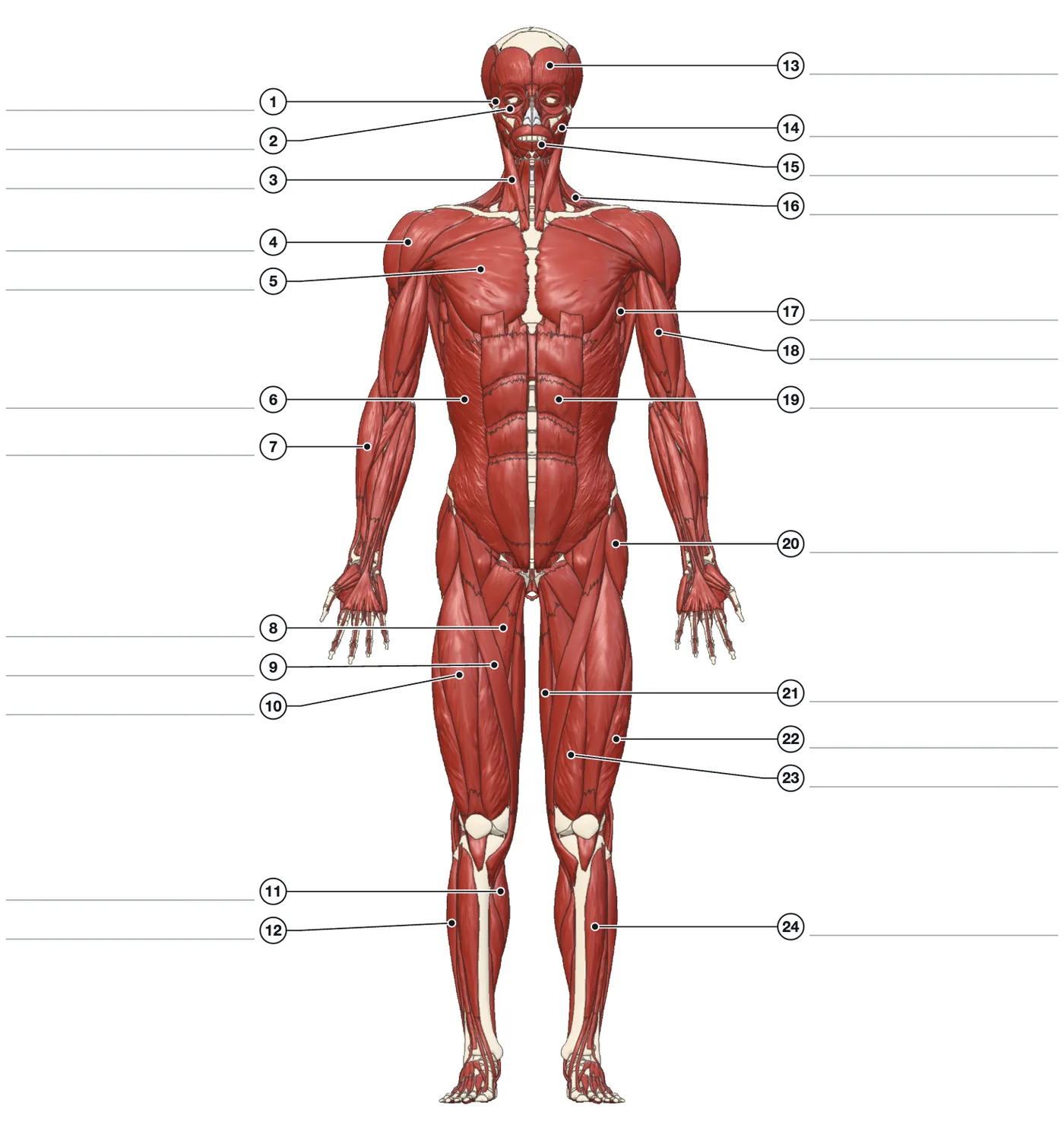
Label it yourself: the muscles (front)
Drag each name onto its line, or tap a name and then its line, and check your answers.
Word bank
0 of 24 placed
Drag a name onto its numbered line, or tap a name and then the line.
Your answers
- 1
- 2
- 3
- 4
- 5
- 6
- 7
- 8
- 9
- 10
- 11
- 12
- 13
- 14
- 15
- 16
- 17
- 18
- 19
- 20
- 21
- 22
- 23
- 24
5. Motor units: how the nervous system commands movement
A muscle never fires on its own. Every voluntary contraction begins in your nervous system, with a signal that travels from your brain or spinal cord out along a nerve cell to the muscle fiber. The nerve cell that carries this command is a motor neuron, and the point where it meets a muscle fiber is a specialized junction called the neuromuscular junction - StatPearls, Physiology of the Neuromuscular Junction. When the electrical signal reaches the end of the motor neuron, it releases a chemical messenger called acetylcholine across a tiny gap, and that messenger is what tells the muscle fiber to release its calcium and contract. This is the exact link between "I want to move" and the sliding filaments doing the work.
One motor neuron does not control just one fiber. It branches and connects to a whole group of fibers, and the neuron plus all the fibers it commands is called a motor unit, the smallest chunk of muscle the nervous system can switch on or off at once. Motor units come in different sizes, and this is the clever part. A muscle that needs fine control, like the ones moving your eyes or fingers, uses tiny motor units where one neuron commands only a handful of fibers, so you can adjust force in delicate steps. A muscle built for raw power, like the ones in your thigh, uses large motor units where one neuron commands hundreds of fibers at once.
This design is how you can pick up an egg or a barbell with the same arm without crushing one or dropping the other. Robots are now learning to handle objects from human examples too: RobotTraining.jobs' table of robot training data, kept by the same team that makes Humanome, lists the data behind dozens of robot foundation models, in hours where their makers state it, and how much of it people made by steering robots remotely or filming their own hands. To lift something heavy, your nervous system activates more motor units, a process called recruitment, and it can also make each unit fire faster. Recruitment follows an orderly rule, switching on the smallest, most fatigue-resistant units first and calling in the big powerful ones only when the load demands it. Here is the chain of command in a single voluntary movement:
How you move on command: your brain or spinal cord sends a signal down a motor neuron, the neuron releases acetylcholine at the neuromuscular junction, the muscle fiber releases calcium, the sliding filaments contract, and to lift more the nervous system recruits more motor units. Every deliberate motion is this loop, run thousands of times.
This tight partnership between nerve and muscle is why so many movement problems are really nervous-system problems, and why conditions that damage motor neurons or the junction between them and muscle rob people of movement even when the muscle itself is intact. To see how the command centers upstream are organized, our guide to the brain and nervous system maps the wiring that ultimately drives every muscle. The muscle is the actor; the nervous system is the director.
6. Fueling the machine: aerobic, anaerobic, and fatigue
Every cross-bridge stroke spends ATP, and your muscles store only a few seconds' worth at any moment. To keep moving, a working muscle must regenerate ATP as fast as it burns it, and it has two main ways to do so. The first is aerobic ("with oxygen"): fibers combine fuel with oxygen to produce ATP cleanly and in large amounts, the way an engine burns fuel with plenty of air. Aerobic metabolism is efficient and can run for hours, but it is not the fastest, so it powers endurance activity like walking, jogging, or cycling, where demand is steady and oxygen can keep up - OpenStax, Muscle Fiber Types.
The second way is anaerobic ("without oxygen"): when you need power faster than oxygen can be delivered, fibers break down stored sugar without oxygen to make ATP quickly. This is the burst system, and it drives short, intense efforts like a sprint or a heavy lift. But it comes at a cost. Anaerobic metabolism produces far less ATP per unit of fuel and generates a byproduct, lactate (often called lactic acid), that builds up during hard effort. Lactate is not the villain it is made out to be, and it is actually a usable fuel the body clears within minutes to a couple of hours after you stop, but the acidic conditions of an all-out effort do contribute to the burning sensation and the feeling that a muscle simply cannot go on.
Your muscles are not all the same in how they prefer to fuel themselves, and this is where fiber types come in. Slow-twitch (Type I) fibers are built for aerobic endurance: they are fatigue-resistant, rich in the machinery for burning oxygen, and dominate in muscles that work all day, like your postural muscles. Fast-twitch (Type II) fibers are built for anaerobic power: they contract quickly and forcefully but tire fast. Most muscles are a mix, and the balance varies from person to person and shifts with training. Here is the contrast:
- Slow-twitch (Type I): aerobic, fatigue-resistant, powers endurance and posture.
- Fast-twitch (Type II): anaerobic, fast and powerful, tires quickly, powers sprints and lifts.
This brings us to the most misunderstood topic in all of exercise: the ache you feel a day or two after a hard workout. That soreness is not lactic acid, a myth that refuses to die. Lactate is long gone by then. The delayed ache, called delayed onset muscle soreness (DOMS), comes from microscopic damage to muscle fibers, especially after unfamiliar or lengthening (eccentric) movements, and it typically peaks 24 to 72 hours after exercise as the body inflames and repairs the tissue - MedlinePlus, Sore Muscles from Exercise. That repair process, uncomfortable as it is, is exactly how muscle gets stronger, which is the subject we turn to next.
7. Cardiac and smooth muscle: the tissue you never think about
While skeletal muscle waits for your command, two other muscle types run your body without ever consulting you. The first is cardiac muscle, the tissue that forms the wall of your heart and does nothing but squeeze, relentlessly, for your entire life. Its most extraordinary property is that it never fatigues. A skeletal muscle held tight for even a minute begins to burn and fail, yet cardiac muscle contracts roughly 100,000 times a day and more than 2.6 billion times over an average lifetime without a single rest - Cleveland Clinic, Fun Facts About Your Heart. It manages this because it is exceptionally rich in the tiny power plants (mitochondria) that make ATP aerobically, so it essentially never runs out of fuel.
Cardiac muscle has another trick that skeletal muscle lacks: it can generate its own rhythm. Special cardiac cells fire on their own and pass the signal from cell to cell, so the heart beats even with no input from the brain. This is why the heart is both a muscle and a self-timing pump, a subject our companion guide to how the human heart works explores in full, from the four chambers to the electrical wiring that keeps cardiac muscle firing in perfect order. It is worth appreciating that the hardest-working muscle you own is one you will never consciously move.
The third type, smooth muscle, is the quiet workhorse lining your hollow organs, and it is everywhere the action is involuntary - Cleveland Clinic, Smooth Muscle. It wraps the walls of your digestive tract, where it squeezes in coordinated waves called peristalsis to push food from your throat to the far end of your gut, a process our guide to the digestive system follows from swallow to absorption. It lines your blood vessels, where it tightens or relaxes to widen and narrow the pipes, directly setting your blood pressure, a role covered in how the circulatory system works. And it rings your airways, your bladder, the iris of your eye, and even the tiny muscles that raise the hair on your arms. Smooth muscle is slow, tireless, and utterly essential, and you spend your whole life unaware of it. All three types can be explored together in the muscular system view, where the voluntary and involuntary tissue sit as one layer of the body.
8. How muscle adapts: training and hypertrophy
Muscle is not a fixed asset. It is a responsive tissue that grows or shrinks based on the demands you place on it, and this adaptability is the single most hopeful fact in this entire guide. The principle is old and simple: challenge a muscle beyond what it is used to, and it rebuilds itself stronger. Sit idle, and it gives up what it no longer needs. Nothing else in your body responds so directly and so reliably to how you choose to use it, which means the state of your muscle at any age is, to a large degree, something you have real influence over.
The growth process is called hypertrophy, and it is essentially controlled damage and repair. When you lift a weight or work a muscle hard, especially against resistance, you create tiny disruptions in the muscle fibers. In the hours and days that follow, your body repairs those fibers and, given enough protein and rest, adds a little extra, thickening the fibers so they can handle the load next time. Repeat this cycle over weeks and the muscle visibly grows and, more importantly, gets stronger. Notice that the growth happens during recovery, not during the workout itself: the workout is the stimulus, and the meal and the sleep afterward are where the building happens.
Two things drive hypertrophy, and both are within reach for almost anyone. The first is mechanical tension, the strain of working a muscle against meaningful resistance, whether that is weights, resistance bands, or your own body weight. The second is adequate protein and recovery, because protein is the raw material your body uses to rebuild fibers, and repair takes time. Importantly, strength improvements in the first weeks of training come less from bigger muscle than from the nervous system learning to recruit motor units more effectively, which is why beginners get noticeably stronger before they look any different. The lesson for anyone starting out is that early progress is real even when the mirror is slow to show it, and consistency over weeks and months is what turns a stimulus into a lasting, stronger, more capable body.
9. How muscle declines: disuse and age
The same responsiveness that lets muscle grow also lets it fade, and the tissue is unforgiving of neglect. Stop using a muscle and it atrophies, shrinking and weakening with surprising speed. Anyone who has worn a cast for a few weeks has seen it: the limb emerges visibly thinner, because the body sheds muscle it is not being asked to use. This is not a flaw but an efficiency, since muscle is metabolically expensive to maintain, so the body trims what it does not need. The practical consequence is blunt: muscle you do not use, you lose, and that logic operates at every age.
Age adds a second, slower decline layered on top of disuse. Starting around age 30, adults naturally lose roughly 3% to 5% of muscle mass per decade, a loss that quietly accelerates in later life - Harvard Health, Preserve Your Muscle Mass. Over a lifetime the total is substantial: many men lose about 30% of their muscle mass as they age. This age-related muscle loss has a name, sarcopenia, and when it becomes severe it is a genuine medical condition, not just a cosmetic one - Cleveland Clinic, Sarcopenia. Estimates vary with how it is defined, but researchers reckon that roughly 10% to 20% of older adults have sarcopenia, and the figure climbs steeply with age.
Sarcopenia matters far beyond strength, and this is the point often missed. Muscle is what keeps an older person steady on their feet, and losing it is a leading driver of the falls and fractures that can end independence. Weak muscles also make everyday tasks exhausting, drain metabolic health, and are linked to worse outcomes from illness and surgery. The encouraging half of the story is that sarcopenia is not a fixed sentence of aging: the decline is driven substantially by inactivity, and the same resistance training that builds muscle in a twenty-year-old builds it in an eighty-year-old too, just more slowly. Muscle stays trainable for life, which is exactly why what you do about it matters at every age.
10. How to keep your muscle healthy
Everything in this guide points to one liberating conclusion: your muscle responds to how you treat it, at any age, so keeping it strong is largely within your control. The habits that build and preserve muscle are neither exotic nor expensive, and they target the exact mechanisms we have walked through: give the tissue a reason to stay strong, give it the raw material to rebuild, and keep it moving. Getting this right pays off in strength, in steadiness, in metabolic health, and in the plain ability to keep doing the things you love as the years pass.
The single most powerful lever is resistance training, the deliberate work of making muscles push or pull against a load. This is the specific stimulus that triggers hypertrophy and, just as importantly, the one that halts and reverses age-related loss. National guidelines recommend that adults do muscle-strengthening activities on 2 or more days a week, working all the major muscle groups, alongside at least 150 minutes of moderate aerobic activity - CDC, Physical Activity for Adults. Resistance work does not require a gym: body-weight exercises, resistance bands, and household objects all supply the tension that muscle needs to grow.
The second lever is protein, the raw material for rebuilding fibers. The standard recommended dietary allowance is about 0.8 grams per kilogram of body weight per day, but a growing body of evidence suggests older adults benefit from more, closer to 1.0 to 1.3 grams per kilogram, especially when combined with resistance exercise, to overcome the muscle's reduced responsiveness with age - NIH/PMC, Protein Requirements for Older People. Spreading protein across meals helps, since muscle-building is triggered meal by meal. Beyond training and protein, the third lever is simply to keep moving, because the tissue you use is the tissue you keep. A few core habits capture the whole strategy:
- Train against resistance at least 2 days a week, hitting all the major muscle groups.
- Eat enough protein, spread across your meals, especially as you age.
- Stay generally active, since sitting still is what tells muscle to waste away.
- Recover well, because muscle is rebuilt during rest and sleep, not during the workout.
Only a minority of adults currently manage this: in the United States, 46.9% of adults meet the aerobic guideline, but just 24.2% meet both the aerobic and the muscle-strengthening targets - CDC/NCHS, Physical Activity Among Adults. That gap is an opportunity, because the muscle-strengthening piece is precisely the part that protects you from sarcopenia and keeps you independent in later life. You do not have to become an athlete. You have to give your muscles a regular reason to stay strong, feed them, and let them recover, and the tissue does the rest.
11. See it in 3D and keep exploring
Reading about muscle is one thing; seeing it wrap the skeleton in three dimensions is another. Everything described in this guide, the layer of skeletal muscle over the bones, the heart's own cardiac muscle, the smooth muscle lining the organs, is waiting in the live model. This is exactly what Humanome was built for: to make the body explorable by anyone, with no medical training required. When an abstract idea like "muscle pulls bone across a joint" becomes something you can rotate and point at, it stops being a phrase and becomes a place.
Start at the explorer home and peel back the outer layers to reach the muscular system. Open the muscular system view to see the tissue that covers almost the entire skeleton, then bring the bones into view together with the skeleton and muscular layers side by side to watch how muscle and lever fit as one moving frame. Seeing the two systems together is the fastest way to grasp why a muscle can only pull, and why every joint needs opposing muscles to move both ways.
Muscle does not work alone, and neither should your exploration of the body. The cardiac muscle you read about here is covered in full in how the human heart works, and the smooth muscle that runs your plumbing appears in the digestive system as the peristalsis that moves your food and in how the circulatory system works as the muscle that tunes your blood vessels. The bones your skeletal muscle pulls on are the subject of the human skeleton, bones, and joints, and the nervous system that commands every contraction is mapped in the brain and nervous system. Each system connects to your muscle, and the explorer lets you move between them freely.
12. The takeaway
Strip away the detail and muscle is one clean idea: a tissue that converts chemical energy into movement by sliding tiny protein filaments past one another, powered by ATP and switched on by calcium and a nerve signal. You own three versions of it: skeletal muscle that you command to move your bones, tireless cardiac muscle that pumps your blood, and quiet smooth muscle that runs your gut, vessels, and airways. The most important thing to know is that skeletal muscle is not fixed. It grows when you challenge it and fades when you neglect it, at every age, which means the strength and steadiness of your body over a lifetime is largely a matter of how you use it. Train it, feed it, keep it moving, and it will keep moving you. The best way to make it stick is to see it: open the Humanome 3D explorer and watch the muscular system wrap the body with your own eyes.
This article is general health education, not medical advice. It cannot diagnose or treat any condition. For questions about your own muscle health, exercise, or nutrition, or for muscle weakness, pain, or wasting that concerns you, please consult a qualified clinician.