How the Circulatory System Works
· 26 min read · Humanome
A clear tour of the body-wide delivery network that keeps every one of your cells alive.
Your blood travels through roughly 60,000 miles of vessels, more than twice the distance around the Earth, and it makes a complete lap of your body about every 23 seconds - Cleveland Clinic, Circulatory System. While you read this sentence, that network is quietly delivering oxygen to your brain, fuel to your muscles, and heat to your skin, then carrying the waste away. This guide is about that network: not the heart that pushes the fluid, but the pipes and the fluid itself.
The heart gets most of the attention, and it deserves a guide of its own (we wrote one on how the human heart works). But a pump is useless without pipes to push through, and the arteries, veins, and capillaries are where the real work of the body actually happens. Most of the conditions people fear, high blood pressure, high cholesterol, clogged arteries, blood clots, are not heart problems at all. They are vessel problems, or blood problems, and they make a lot more sense once you see the network as a whole.
Throughout, you can open the live 3D model and turn the vessels over in your hands. Humanome is an interactive 3D explorer of the body, and the cardiovascular system is one of the layers you can peel back, click into, and read. Watch for the links: they open the exact structure being discussed.
Contents
- The problem circulation solves: why cells need a delivery service
- The big picture: two circuits, one continuous loop
- Arteries, veins, and capillaries: three jobs, three designs
- What blood is actually made of
- When the blood runs low: anemia
- Blood pressure: a property of the whole network
- Atherosclerosis: when the pipes fur up
- Trouble on the return side: deep vein thrombosis
- How to keep your vessels healthy
- See it in 3D and keep exploring
- The takeaway
1. The problem circulation solves: why cells need a delivery service
Every one of your cells is a tiny factory that runs day and night. It needs a constant supply of oxygen and fuel coming in, and it produces a steady stream of carbon dioxide and other waste that has to be carried away before it builds up. A single cell floating in water solves this effortlessly: molecules drift in and out across its surface by diffusion, the natural tendency of things to spread from where they are crowded to where they are sparse. Diffusion is free and automatic, but it has one fatal limitation. It only works over microscopic distances.
You are not a single cell. You are roughly thirty trillion of them, packed into tissues and organs, and most of them sit deep inside a body far from any air or food. Diffusion alone could never reach them: a cell at the center of your thigh would suffocate long before oxygen drifted in from your skin. So the body solves the distance problem with bulk flow. It dissolves and loads oxygen and nutrients into a fluid, blood, then physically pushes that fluid past every cell in the body, close enough that diffusion only has to finish the last tiny gap. Bulk flow does the long haul, diffusion does the final handoff, and together they keep the whole body fed.
That single idea explains why the circulatory system is built the way it is. To make bulk flow work, you need exactly three things, and the body has all three:
- A pump to generate pressure and keep the fluid moving. That is the heart.
- A network of pipes to route the fluid everywhere and bring it back. Those are the blood vessels.
- A transport fluid loaded with carriers for oxygen, fuel, and waste. That is the blood.
This guide focuses on the last two, the pipes and the fluid, because the pump has its own story. It is worth pausing on the sheer scale of the plumbing, though. Those 60,000 miles of vessels range from the aorta, wider than a garden hose, down to capillaries so fine that it would take ten of them side by side to match the width of a single human hair - Cleveland Clinic, Circulatory System. The whole system is a masterclass in getting a fluid to within a hair's breadth of every cell you own. You can open the explorer and start peeling back layers to find the vessels threading through the body.
2. The big picture: two circuits, one continuous loop
Here is the first thing to understand about the network: blood does not flow in one big circle. It flows in two circuits arranged in sequence, and every drop of blood passes through both, over and over, forever. Once you see why, the whole layout of the cardiovascular system clicks into place.
The reason there are two circuits is that blood has two different errands. First, it visits the lungs to drop off carbon dioxide and pick up fresh oxygen. Second, it visits the rest of the body to deliver that oxygen and collect the waste. These two trips need different pressures and must never mix (you do not want oxygen-poor blood diluting the oxygen-rich supply), so the body runs them as two separate loops, connected in a line so that blood flows through one, then the other, then back again.
The first circuit is the pulmonary circulation. Oxygen-poor blood returning from the body is pumped a short distance to the lungs, where it releases carbon dioxide and soaks up oxygen, then returns. This is the loop that connects circulation to breathing, and if you want to see how the lungs load that blood with oxygen, our companion guide on how your lungs work follows the story from there. The second circuit is the systemic circulation, the big one: freshly oxygenated blood is pumped out under high pressure to your brain, gut, kidneys, muscles, skin, and toes, delivering oxygen everywhere and returning drained of it.
The pump mechanics that drive these two circuits (the four chambers, the valves, the electrical rhythm) belong to the heart's own guide, so we will leave them there. What matters for the network is the path the blood takes and the fact that it never ends:
One full lap: body (oxygen-poor) into the right heart, out to the lungs to load oxygen (pulmonary circuit), back to the left heart, out to the whole body to deliver it (systemic circuit), and back to the start. Blood is never used up. It circulates endlessly, reloaded at the lungs and unloaded at the tissues, roughly once every 23 seconds.
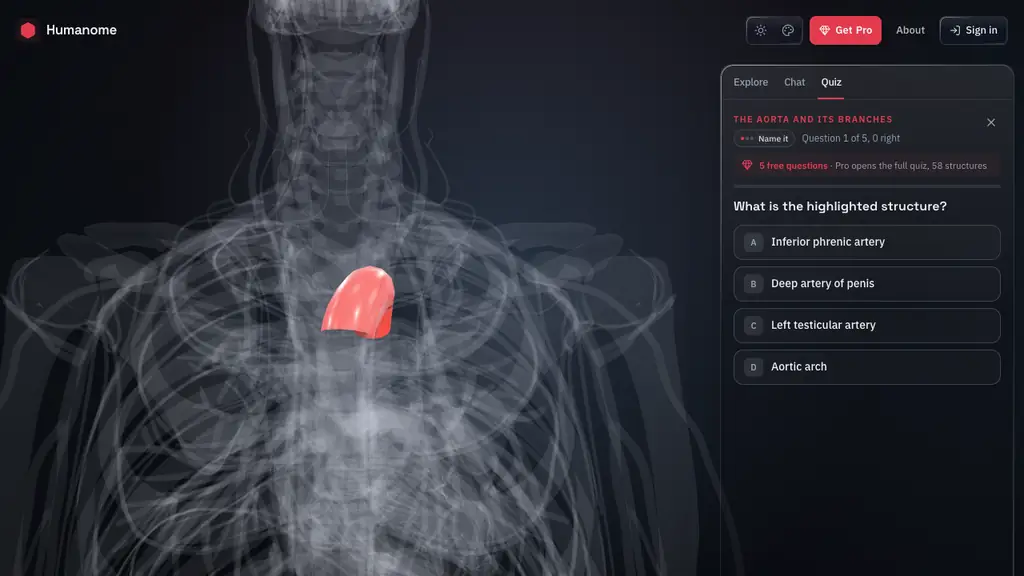
Notice the loop is truly continuous: the body is both where blood leaves and where it returns. That is why the word circulation is literal. To feed the whole systemic circuit, the left side of the heart drives blood into the body's largest artery, the aorta, which you can open in the model as the ascending aorta rising out of the heart, then follow as it becomes the thoracic aorta arching down through the chest and the abdominal aorta running down through the belly. Every artery in your body branches, ultimately, off that one great trunk. You can also see the whole network at once in the cardiovascular system view.
3. Arteries, veins, and capillaries: three jobs, three designs
If you remember one distinction from this article, make it this one, because "arteries versus veins" is the most common point of confusion about the body, and the answer is beautifully simple. The three types of vessel are not variations on one pipe. They are three different tools for three different jobs, and each one is shaped by the job it does.
Arteries carry blood away from the heart, and they do it under high pressure. Every time the heart contracts, it fires a surge of blood into the arteries, so their walls have to handle a repeated, forceful pounding. That is why arteries are thick, muscular, and elastic: the elastic wall stretches to absorb each surge and then springs back to keep the blood moving smoothly between beats, smoothing the pump's on-off rhythm into steadier flow. If you press your fingers to your wrist or your neck, the pulse you feel is an artery expanding with each heartbeat. Arteries branch into smaller and smaller vessels, ending in tiny arterioles whose muscular walls can widen or narrow to control how much blood reaches each region.
Veins carry blood back to the heart, and by the time blood reaches them it has already given up most of its pressure crossing the capillaries. So veins face the opposite problem: not too much pressure, but too little. Their walls are thinner and less muscular, and they hold a large share of your blood volume in reserve. Getting low-pressure blood back uphill from your feet to your chest takes help, and veins have two clever solutions. Many contain one-way valves that stop blood from sliding backward between pushes, and the veins running through your muscles get squeezed every time those muscles contract, so ordinary movement acts as a pump. This is exactly why sitting still for hours is bad for circulation and why walking gets the blood moving.
Between the arteries and the veins sit the capillaries, and they are the entire point of the system. Everything else exists to serve them. A capillary is a vessel so narrow that red blood cells pass through in single file, and its wall is just one cell thick, thin enough for oxygen, nutrients, and waste to slip across. This is where exchange finally happens: oxygen and fuel diffuse out of the blood into the tissues, and carbon dioxide and waste diffuse back in. The vast branching of arteries and the pooling of veins are all in service of getting blood to and from these microscopic exchange surfaces, which together add up to an enormous total area threaded through every tissue.
Here is the sequence a drop of blood follows on the systemic side, and it is always the same order:
The one-way route through the body: heart, into a large artery (the aorta), into smaller arteries, into arterioles, into the capillaries where exchange happens, into small veins (venules), into larger veins, and back to the heart. Arteries branch outward under pressure, capillaries do the trading, veins pool the return and lift it home.
The most important thing to unlearn is the idea that "arteries carry oxygen-rich blood and veins carry oxygen-poor blood." That is true almost everywhere in the body, but the pulmonary circuit flips it: the pulmonary artery carries oxygen-poor blood to the lungs, and the pulmonary veins carry oxygen-rich blood back. So the real rule is about direction, not oxygen: arteries always carry blood away from the heart, veins always carry it back, whatever the blood is carrying. Hold that straight and the whole network stays clear.
4. What blood is actually made of
We have been calling blood a "transport fluid," but that undersells it. Blood is a living tissue, one of the few in your body that flows, and it is doing several jobs at once: hauling gases and nutrients, carrying heat, ferrying immune cells, and sealing its own leaks. If you spin a tube of blood in a centrifuge, it separates cleanly into layers, and those layers are the best map of what blood is. Roughly 55% of blood is plasma, the pale yellow liquid, and the remaining 45% is cells (about 44% red cells and about 1% white cells and platelets combined) - Cleveland Clinic, Blood.
The plasma is mostly water, and its job is to be the river everything else rides in. Dissolved in it are proteins, salts, hormones, glucose, and waste products, all being carried between organs. Plasma is why blood can deliver a hormone made in one gland to a target across the body, and it is also the main way carbon dioxide travels back to the lungs, mostly dissolved as bicarbonate rather than riding on a cell. Because plasma is so much water, it is also how blood carries and spreads heat, which is a big part of how your body keeps a steady core temperature.
The famous component is the red blood cell, and it exists for one reason: to carry oxygen. Each red cell is packed with hemoglobin, an iron-containing protein that grabs oxygen in the lungs and releases it in the tissues. Water can barely dissolve any oxygen at all, so without hemoglobin your blood could not carry nearly enough to keep you alive. Hemoglobin is also why blood is red, and why oxygen-rich arterial blood is a brighter red than the darker, oxygen-poor blood in your veins. An adult carries about 5 liters of blood in total, and a huge share of it is red cells crammed with this oxygen carrier - Cleveland Clinic, Blood.
The last two components are fewer in number but essential. White blood cells are the mobile arm of your immune system: they patrol the bloodstream and slip out into tissues to find and destroy bacteria, viruses, and other threats, which is why an infection often raises their count. Platelets are tiny cell fragments that rush to any break in a vessel wall and clump together to form a plug, starting the clot that stops you from bleeding. Here is the whole tissue in one view:
- Plasma (about 55%): the watery river that carries proteins, hormones, waste, heat, and dissolved carbon dioxide.
- Red blood cells (about 44%): packed with hemoglobin to carry oxygen from the lungs to every tissue.
- White blood cells (part of the last 1%): the immune patrol that hunts and destroys invaders.
- Platelets (part of the last 1%): fragments that clump to seal leaks and start clots.
That clotting ability is a double-edged sword, and it is worth remembering as we go. The same platelets and clotting proteins that save your life when you cut yourself can, in the wrong place, form a clot inside an intact vessel and block blood flow. Two of the most dangerous conditions in this guide (a clot in a coronary artery, and a clot in a deep leg vein) are really this life-saving system misfiring inside the pipes.
5. When the blood runs low: anemia
Because so much of blood's job comes down to hemoglobin carrying oxygen, one of the most common blood disorders is simply not having enough of it. This condition is anemia, and it happens when the blood has a lower-than-normal amount of red blood cells or hemoglobin, so it cannot carry as much oxygen as the body needs. The result is a body that is quietly, chronically short of oxygen, even though the lungs and heart may be working perfectly.
Anemia is astonishingly widespread. Globally, it affects roughly 1.92 billion people, about 24% of the world's population, making it one of the most common health conditions on Earth - Global Burden of Disease Study 2021, NIH PMC. It falls hardest on women and young children: among women of reproductive age, prevalence reaches about 33.7%, roughly one in three, and by far the leading cause is dietary iron deficiency, which accounts for around two-thirds of all cases - Global Burden of Disease Study 2021, NIH PMC. Iron matters here because it sits at the heart of every hemoglobin molecule, so without enough iron the body cannot build enough working oxygen carriers.
Because the whole body runs on oxygen delivery, the symptoms of anemia show up everywhere at once and are easy to dismiss. Common signs include:
- Fatigue and weakness that rest does not fix, because tissues are running low on oxygen.
- Pale skin, since less hemoglobin means less of the red that gives skin its color.
- Shortness of breath and a fast heartbeat, as the heart and lungs work harder to compensate.
- Dizziness or cold hands and feet, from oxygen being rationed to the body's edges.
The reassuring part is that the most common form, iron-deficiency anemia, is usually straightforward to diagnose with a simple blood test and often treatable, whether through diet, iron supplements, or by finding and fixing a source of slow blood loss. The important lesson for understanding the network is that anemia shows how tightly everything is coupled: a shortage in the blood itself forces the heart to beat faster and the lungs to work harder, straining the whole system to make up for a delivery problem it cannot fully solve. You can explore anemia in the 3D model to see how a blood-level problem ripples through the body, or read more on the anemia condition page.
6. Blood pressure: a property of the whole network
People tend to think of blood pressure as a heart number, but it is really a property of the entire network: the pump, the fluid, and above all the pipes. Blood pressure is simply the force that circulating blood exerts against the walls of your arteries, and it depends on how hard the heart pushes, how much blood is in the system, and how much the arteries resist the flow. Change any of those and the pressure changes, which is why it is one of the most revealing single numbers in all of medicine.
A reading has two numbers for a reason that ties back to the heartbeat. The top number, systolic pressure, is the peak: the pressure in your arteries the moment the heart contracts and fires blood in. The bottom number, diastolic pressure, is the resting pressure between beats, while the heart refills. So "120 over 80" means the pressure surges to 120 and never drops below 80. For most adults, a normal blood pressure is below 120/80 mmHg - American Heart Association, Understanding Blood Pressure Readings. The gap between the peak and the resting pressure is smoothed out by those elastic artery walls, which is one reason healthy, springy arteries matter so much. Taking and reading blood pressure is everyday nursing work, and AI developers pay registered nurses by the hour to grade how a model answers patient-care questions like these; the nursing roles listed on AITraining.jobs, one of our own sites, show where that work is open.
The common problem is not pressure that is too low but pressure that is chronically too high, a condition called hypertension. And here is where the network view pays off: high pressure is usually a pipe problem as much as a pump problem. When arteries stiffen with age or disease, they lose the elasticity that used to absorb each surge, so the peak pressure climbs. High pressure then damages the vessels further, which stiffens them more, in a slow feedback loop. The kidneys are deeply involved too, because they control how much fluid and salt stay in the blood, which is why our guide to how your kidneys work is really a blood-pressure guide in disguise.
The scale of hypertension is staggering, and it is dangerous precisely because you cannot feel it.
Nearly half of US adults, about 48%, or 119.9 million people, have high blood pressure - CDC, High Blood Pressure Facts. It usually causes no symptoms while it quietly strains the heart and damages arteries, raising the risk of heart attack, stroke, and kidney disease. In 2024, high blood pressure was a primary or contributing cause of 680,179 deaths in the United States - CDC, High Blood Pressure Facts. Because it is silent, the only way to catch it is to measure it, which is why knowing your numbers is the single most valuable habit in this whole guide. You can watch hypertension light up the vessels it strains in the model, or read the full hypertension condition page. As for whether GLP-1 medicines lower blood pressure, GLPcompare's page on the question, on a site that shares an owner with Humanome, gives the trial findings and notes that no current label lists high blood pressure as an approved use.
7. Atherosclerosis: when the pipes fur up
If hypertension is the pressure problem, atherosclerosis is the clogging problem, and it is the single most important disease of the vessel network. The name comes from Greek roots meaning "hard porridge," which is a surprisingly good description. Over years, a fatty, waxy substance called plaque builds up on the inside walls of arteries, made of cholesterol, fat, calcium, and other material from the blood. As plaque accumulates, the artery hardens and narrows, so less blood can flow through it - NHLBI, Atherosclerosis. Think of a pipe slowly furring up with mineral scale until only a trickle gets through.
The raw material for that plaque is cholesterol, which is why high cholesterol is such a central risk factor. Cholesterol itself is not evil (your body needs it to build cells and hormones), but too much of the wrong kind circulating in the blood feeds the plaque-building process. High cholesterol is nearly as common as high blood pressure: about 86 million US adults have total cholesterol above 200 mg/dL, and nearly 25 million are above the high-risk threshold of 240 mg/dL - CDC, High Cholesterol Facts. Like hypertension, it causes no symptoms at all, so a simple blood test is the only way to know. You can examine high cholesterol in the explorer or read the high cholesterol condition page to see how it feeds vessel disease.
Atherosclerosis matters because of where it strikes and what happens when a plaque breaks. When the furring-up happens in the coronary arteries, the vessels that feed the heart muscle itself, the result is coronary artery disease, the most common form of heart disease. As those arteries narrow, less blood reaches the heart muscle, which can cause chest pain on exertion. The catastrophe comes when a plaque ruptures and a blood clot forms on top of it, suddenly blocking the artery completely: that is a heart attack, and the starved muscle downstream begins to die. About 1 in 20 US adults have coronary heart disease - NHLBI, Coronary Heart Disease, and heart disease overall is the leading cause of death in the United States, responsible for 702,880 deaths in 2022 - CDC, Heart Disease Facts.
The mechanism is so common and so lethal that the numbers are hard to absorb: in the US, someone has a heart attack about every 40 seconds - CDC, Heart Disease Facts. The same plaque process can narrow arteries anywhere: block a vessel to the brain and you get a stroke, narrow the arteries in the legs and you get pain when walking. This is the great lesson of the vessel network: one disease of the pipes, atherosclerosis, is behind an enormous share of the world's most serious illness, and it is largely driven by risk factors you can influence. You can explore coronary artery disease in 3D to see the vessels involved, and read the coronary artery disease condition page for more. To see exactly how a blocked coronary artery starves the heart muscle, our guide to how the human heart works walks through the pump's own private blood supply.
8. Trouble on the return side: deep vein thrombosis
Almost everything that scares people about circulation happens on the artery side, but the veins have a serious danger of their own, and it is one that catches healthy people off guard. It is called deep vein thrombosis, or DVT, and it is a clot problem on the low-pressure return side of the network. Understanding it is a good test of whether the arteries-versus-veins distinction has really landed.
A deep vein thrombosis is a blood clot that forms inside one of the deep veins, usually in the leg. Remember that venous blood is low-pressure and depends on movement and valves to keep flowing uphill toward the heart. When someone sits motionless for a long time (a long flight, a long car ride, a hospital stay after surgery), the blood in the deep leg veins can slow and pool, and slow-moving blood is prone to clotting. The clot itself causes swelling, pain, warmth, and redness in the affected leg, but that is not the real danger.
The real danger is that a piece of the clot can break loose and travel. Because veins all lead back toward the heart, a fragment sweeps up the venous system, passes through the right side of the heart, and lodges in the lungs, blocking blood flow there. This is a pulmonary embolism, and it can be fatal. Together, deep vein thrombosis and pulmonary embolism (grouped as venous thromboembolism) affect up to 900,000 Americans each year and cause an estimated 60,000 to 100,000 deaths, and alarmingly, sudden death is the first symptom in about a quarter of people who have a pulmonary embolism - CDC, Venous Thromboembolism. More than a third of cases are linked to a recent hospital stay, which is why hospitals now work hard to keep patients moving.
The prevention lesson follows directly from the anatomy, and it is refreshingly practical: keep the venous blood moving. On a long journey, get up and walk every couple of hours, flex your calves and ankles while seated, and stay hydrated. The muscle pump you read about earlier is exactly the tool that keeps a clot from forming, which is why movement is not just good for you in general but specifically protective against DVT. You can explore deep vein thrombosis in 3D to see where these clots form on the return side, or read the deep vein thrombosis condition page.
9. How to keep your vessels healthy
Here is the genuinely hopeful part, and it is the reason all of this is worth understanding. Look back at the major conditions in this guide (high blood pressure, high cholesterol, atherosclerosis, coronary artery disease, deep vein thrombosis) and notice that they share the same short list of causes. That means they share the same short list of protections. You do not have to defend against a dozen separate diseases. You have to keep a single network healthy: the pipes clear, the pressure controlled, the blood moving, and the fluid in good shape.
None of the levers are exotic, and that is exactly the point. The same handful of ordinary habits protects the whole network at once, because they all target the same underlying vessel biology. Here are the ones that matter most:
- Know your numbers. Get your blood pressure and cholesterol checked, because both are silent and you cannot feel them.
- Move your body. Regular activity lowers pressure, improves cholesterol, and keeps venous blood flowing against clots.
- Eat for your arteries. A diet rich in vegetables, fruit, whole grains, and healthy fats, and lower in salt and processed food, slows plaque.
- Do not smoke. Tobacco damages vessel walls and accelerates atherosclerosis faster than almost anything else.
- Watch your iron and diet. A balanced diet supports healthy red blood cells and guards against the most common form of anemia.
The single most valuable item on that list is the first, because it is the one people skip. Hypertension and high cholesterol are the two great drivers of vessel disease, and both are completely silent: they cause no symptoms while they quietly damage arteries for years - CDC, High Cholesterol Facts. The only way to catch them is to measure them, and a simple check at a pharmacy or a doctor's visit can flag a problem long before it becomes a heart attack or a stroke. Pair that awareness with movement, a decent diet, and not smoking, and you have addressed the large majority of what damages the vessel network. The system is remarkably forgiving when it is looked after, and the earlier you start, the more of it you preserve.
10. See it in 3D and keep exploring
Reading about a network of vessels is one thing. Seeing it wrap through a whole body is another. Everything described in this guide (the great aorta rising from the heart, the arteries branching outward, the veins pooling the return, the capillaries hidden in every tissue) is waiting for you in the live model. This is exactly what Humanome was built for: to make the body explorable by anyone, with no medical training required.
Start at the explorer home and open the cardiovascular system view to see the whole network at once. Trace the ascending aorta up out of the heart, follow the thoracic aorta through the chest, and continue down the abdominal aorta into the belly, watching the body's largest artery run its full course. Then search any of thousands of conditions and watch the exact structures they affect light up: hypertension, coronary artery disease, high cholesterol, a deep vein thrombosis, or anemia. Seeing which parts of the network a condition touches makes the mechanism stick in a way words alone cannot.
To learn the vessels by name for a test, the major arteries and veins chart lists each one, where it runs and what it supplies or drains, and prints on three pages.
The vessels do not work alone, and neither should your exploration of the body. The pump that drives everything you just read about is covered in how the human heart works. The lungs that reload the blood with oxygen are in how your lungs work. And the kidneys that quietly regulate your blood pressure and filter your blood are in how your kidneys work. Each connects to the circulation, and the explorer lets you move between them freely.

11. The takeaway
Strip away the detail and the circulatory system is a single elegant solution to a distance problem: your cells are too far from air and food to feed themselves, so the body loads oxygen and fuel into blood and pushes it past every cell through 60,000 miles of pipes, running two circuits in sequence (one to the lungs for oxygen, one to the body to deliver it). The arteries carry it out under pressure, the capillaries do the actual trading, and the veins pool it and lift it home. Nearly everything that goes wrong is a specific failure of this network: a stiff, over-pressured system in hypertension, furred-up pipes in atherosclerosis and coronary artery disease, a clot on the return line in DVT, or a shortage in the fluid itself in anemia. And nearly everything that protects it comes down to a few honest habits and knowing your own numbers. It is the most extensive delivery network you will ever own, and now you can see it working in 3D.
This article is for general education, not medical advice. It cannot diagnose or treat any condition. If you have concerns about your blood pressure, cholesterol, or circulation, or you notice warning signs like chest pain, a swollen painful leg, or sudden shortness of breath, please consult a qualified clinician, and in an emergency call your local emergency number right away.